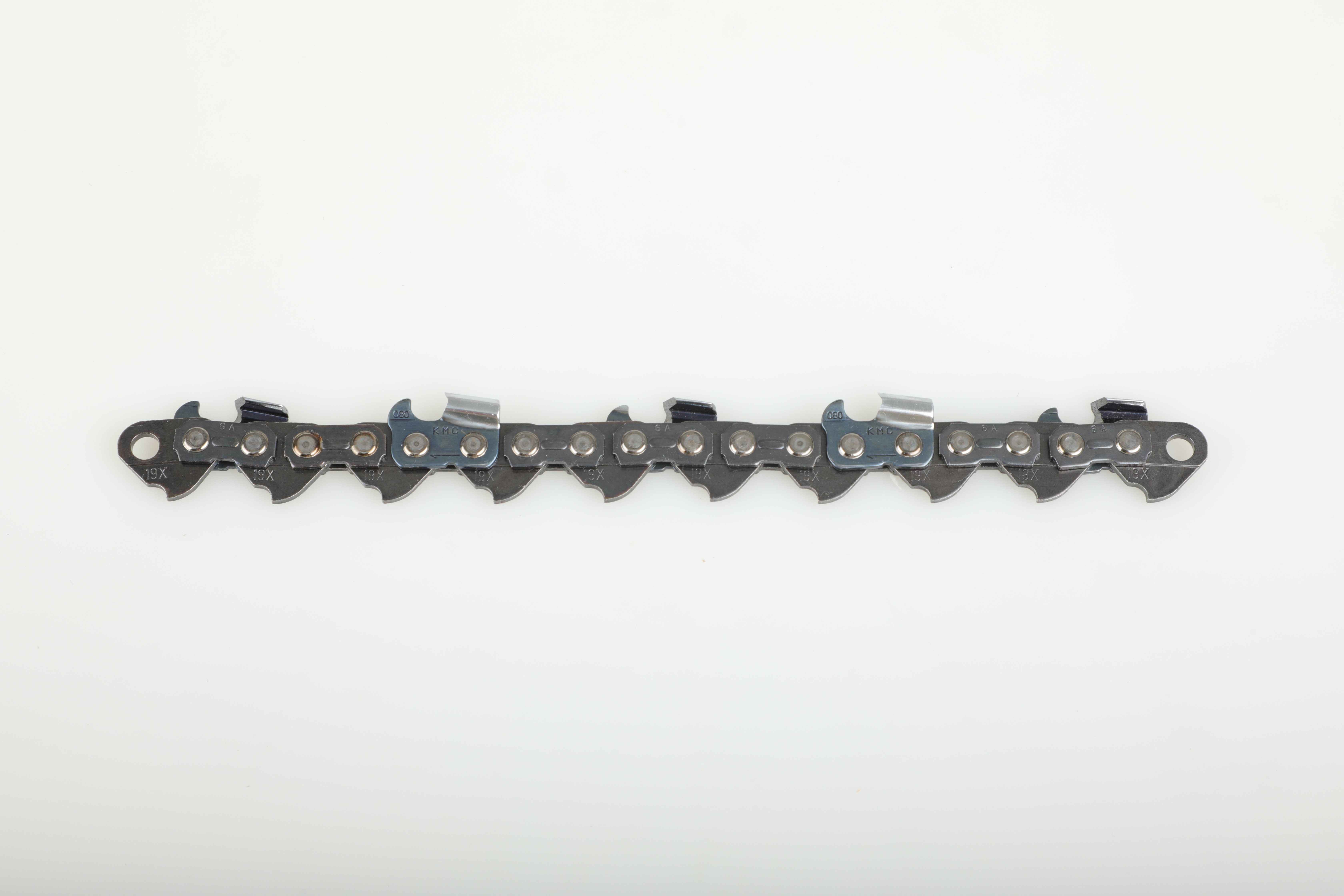
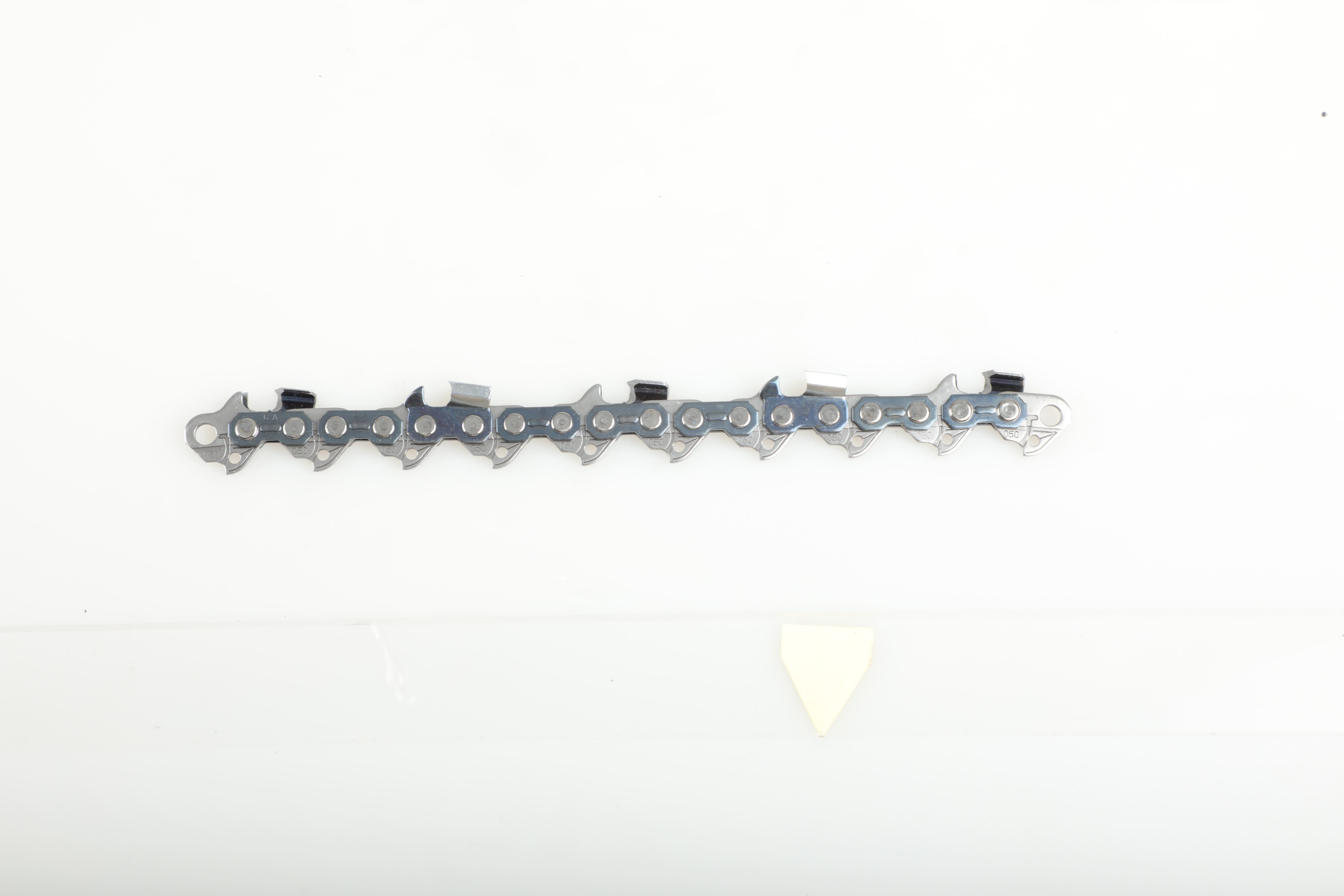
A chainsaw chain size chart should help you read three separate specifications: pitch, gauge and drive-link count. Pitch matches the chain to the drive sprocket and bar-nose system. Gauge matches the drive links to the guide-bar groove. Drive-link count determines the loop length for the installed bar.
Bar length alone cannot determine the correct chain. Two guide bars with the same nominal length may use different pitch, gauge or drive-link counts. Use a chart to organize the information, but take the final size from the bar marking, equipment manual or a verified count of the existing chain.
How to Read a Chainsaw Chain Size Chart
A useful chart separates fit data from application descriptions. The fit data answer whether the loop belongs on the cutting system. Application information helps choose among compatible cutter profiles, but it cannot make an incorrect size fit.
| Chart field | Meaning | Must match |
|---|---|---|
| Pitch | Spacing family of the chain | Drive sprocket and guide-bar nose |
| Gauge | Thickness of the drive link in the bar groove | Guide-bar groove width |
| Drive links | Number of drive links in the loop | Required loop length for the actual bar |
| Cutter profile | Full chisel, semi chisel or another offered design | Application and approved chain configuration |
Read pitch, gauge and drive links as separate fields; all three must be correct.
Write a size in a consistent order, for example: 3/8 pitch, .050 gauge, 72 drive links. The example describes one specific loop size; it is not a recommendation for every bar of a particular length.
Pitch: Match the Sprocket System
Pitch is calculated from the distance between the centers of three consecutive rivets divided by two. In practice, reading the pitch marking is faster and less likely to create confusion. Common product families include 1/4, .325, 3/8 low profile, standard 3/8 and .404.
The pitch name must be interpreted precisely. Standard 3/8 and 3/8 low profile are different cutting systems even though both include the same fraction. Their components should not be treated as automatically interchangeable. The saw, sprocket, bar and chain family must correspond.
| Pitch family | Examples of gauges that may be offered | Selection note |
|---|---|---|
| 1/4 | .043 inch in some compact systems | Check the exact pruning or specialty equipment |
| 3/8 low profile | .043 or .050 inch in offered systems | Use only with compatible low-profile components |
| .325 | .050, .058 or .063 inch depending on product | Read the actual guide-bar gauge |
| Standard 3/8 | .050, .058 or .063 inch depending on product | Do not substitute a low-profile loop |
| .404 | Gauge depends on the specified heavy-duty system | Follow the equipment and bar specification |
The gauge examples are orientation only. Availability varies by product family, and the chart cannot override a marked specification. Review specific ranges for 3/8 low-profile chain, .325 chain, standard 3/8 chain and .404 chain.
Gauge: Match the Guide-Bar Groove
Gauge is the thickness of the drive link where it runs between the bar rails. The bar groove is manufactured for a specific gauge. If the drive link is too thick, it will not seat properly. If it is too thin, the chain will not receive the support intended by the bar design.
Gauge is commonly shown in inches and sometimes with a metric equivalent. Copy the marked value rather than converting casually. A small difference matters because the dimension describes the part that actually runs in the groove.
Clean the bar before reading a faint marking or checking the groove. Wear gloves and isolate the saw from its power source. Measuring worn components can be misleading, so equipment documentation or a clearly marked serviceable bar is preferable to estimating from a damaged chain.
.043 inch is approximately 1.1 mm.
.050 inch is approximately 1.3 mm.
.058 inch is approximately 1.5 mm.
.063 inch is approximately 1.6 mm.
Use these conversions to understand labels, not to round one gauge into another. Order the exact gauge specified for the bar.
Drive-Link Count: Determine Loop Length
Drive links are the lower links that engage the drive sprocket and run in the guide-bar groove. Counting them gives the loop length. Count every drive link, not the sharpened cutters. Cutter count and drive-link count are different values.
To count a loose chain, mark one drive link, lay the loop out safely and count each drive link until returning to the mark. Gloves help protect hands from the cutters. If the original chain is damaged or has been altered, use the bar and saw documentation instead of assuming its count is correct.
The same nominal bar length can use different drive-link counts because bar mount, nose design and saw geometry vary. A chart that assigns one count to every 16-inch or 20-inch bar is therefore only an example chart and cannot be used as a universal replacement guide.
Five Steps to Choose a Size from the Chart
Identify the installed bar. Record its markings and confirm whether it is the original configuration.
Read the pitch. Match it to the sprocket and bar-nose system.
Read the gauge. Match the drive links to the bar groove.
Confirm drive-link count. Use the marked specification or a careful count.
Select cutter style. Choose a compatible full-chisel, semi-chisel or low-kickback design for the work.
Before installation, compare the package with the written size. Seat the drive links in the groove and verify that the chain follows the correct cutting direction. Set tension according to the saw instructions and rotate the chain by hand only after the power source is isolated and while wearing gloves.
If the loop does not seat or tension correctly, stop. Do not modify drive links, bar rails or sprocket components to make it fit. Recheck the three size fields and the low-profile or standard chain family.
Example: Turn the Chart into an Order Line
Suppose the guide bar is marked for .325 pitch and .058 gauge, and the verified loop contains 72 drive links. Record the chain as “.325 pitch, .058 gauge, 72 drive links” before adding a cutter preference. Do not shorten the order to “18-inch .325 chain,” because another 18-inch bar may use a different gauge or drive-link count. The complete line lets the supplier and receiver check the same three fields.
For several saws, create a worksheet with columns for saw model, bar reference, nominal bar length, pitch, gauge, drive links, cutter profile and package SKU. Treat bar length as a reference column, not the size key. When a bar is changed, update the row and verify the chain again. This simple record also prevents similar-looking loops from being returned to the wrong storage bin after sharpening.
Frequently Asked Questions
What three numbers identify a chainsaw chain size?
The key values are pitch, gauge and drive-link count. Pitch matches the sprocket system, gauge matches the guide-bar groove and drive-link count determines loop length. Cutter type is an additional application choice.
Can I find drive-link count from bar length?
Not reliably. Bars with the same nominal length may require different counts because their mounts, noses and saw configurations differ. Read the bar marking, manual or verified existing-chain count.
Is 3/8 low profile the same as standard 3/8?
No. They are different chain and cutting-attachment systems. Confirm the full chain family along with gauge and drive links, and use the bar and sprocket specified for that system.
Where is the chainsaw chain size printed?
Look on the guide bar, in the saw or bar documentation and on the original chain package. Some chains have identification marks, but markings vary, so use reliable documentation when uncertain.
Can two chains share pitch and gauge but not fit the same bar?
Yes. They can have different drive-link counts and therefore different loop lengths. Pitch and gauge must match, but the drive-link count must also be correct for the installed bar.
Conclusion: A chainsaw chain size chart is reliable when it keeps pitch, gauge and drive-link count separate and treats bar length only as context. Record all three fit dimensions, confirm the chain family and then choose a suitable cutter profile. Never force a close-looking loop onto an incompatible cutting system.
If markings are unclear, send KMC photos of the guide bar, saw model and existing drive-link count for size-identification help.