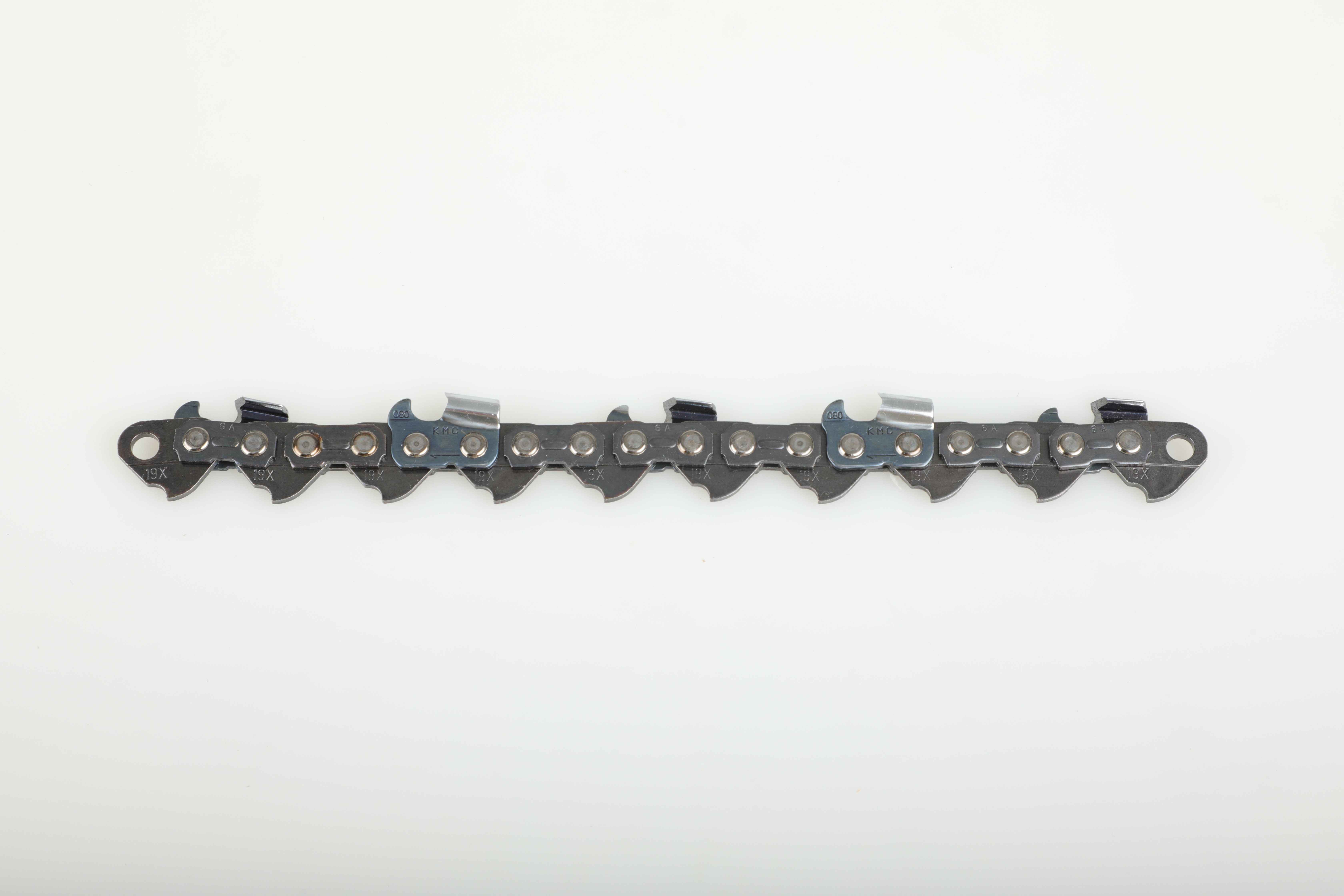
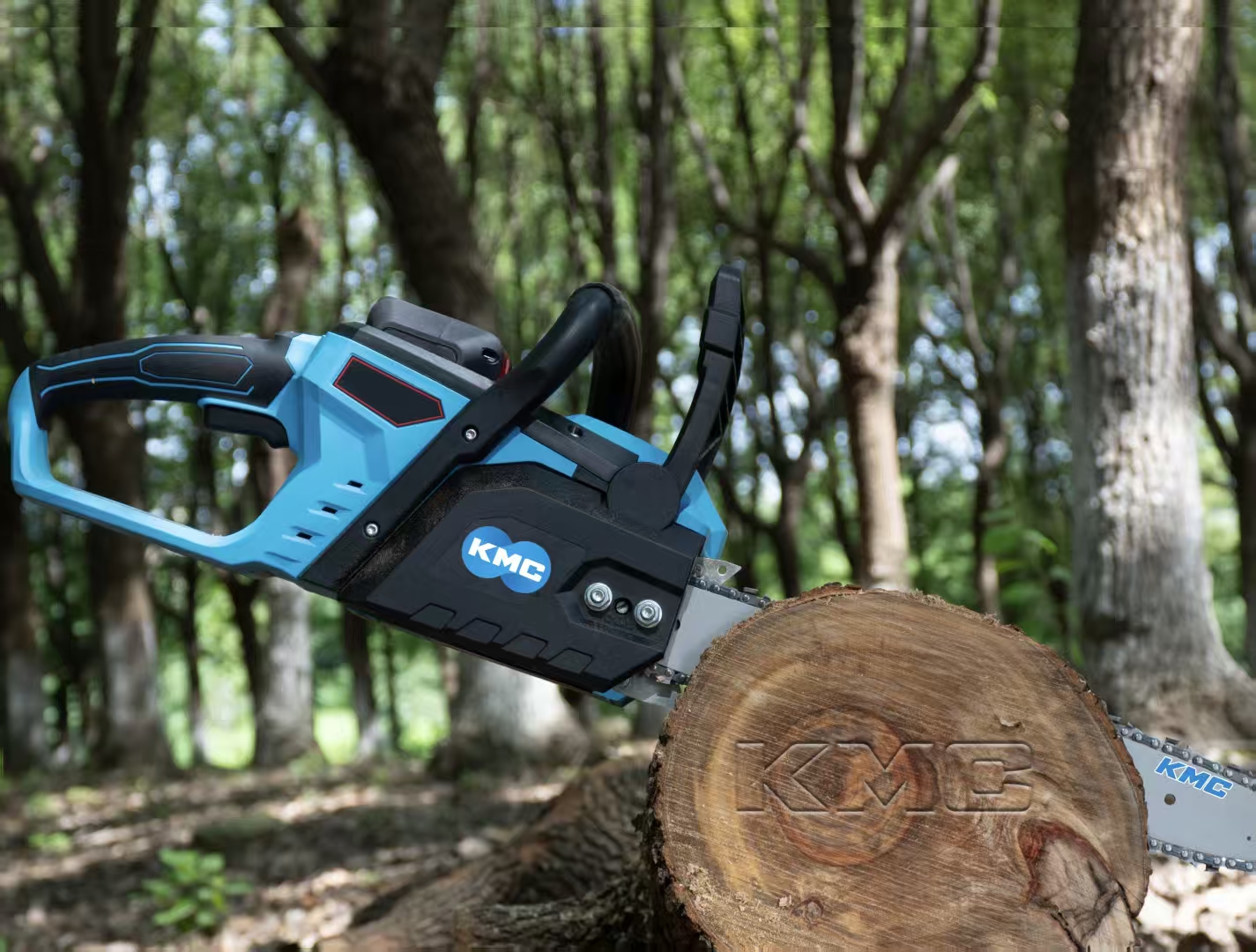
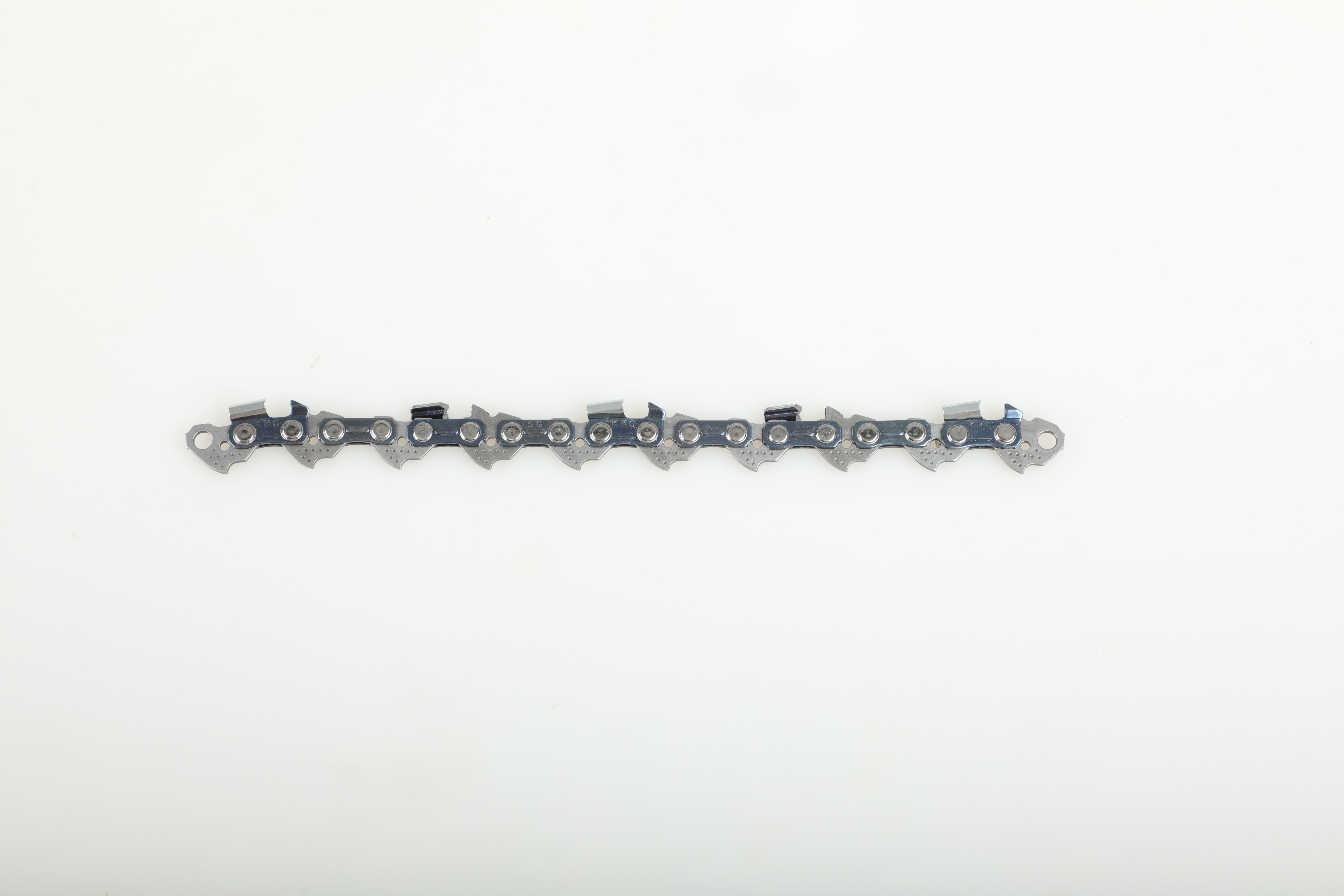
Chainsaw chain pitch is the spacing classification that allows the chain, drive sprocket and guide-bar nose to work together. It is calculated by measuring the distance between the centers of three consecutive rivets and dividing that distance by two. The result identifies a pitch family such as 1/4, .325, 3/8 or .404 inch.
Pitch is a spacing measurement, not a complete chain size. A replacement loop also needs the correct gauge and drive-link count. Two chains can share the same pitch while differing in drive-link thickness, loop length, cutter profile or low-profile versus standard construction.
What Is Chainsaw Chain Pitch?
A chain is built from repeating links joined by rivets. Pitch describes the spacing pattern of those components. The drive sprocket has corresponding pockets or teeth, and many guide bars use a sprocket nose with the same pitch family. If the chain pitch and sprocket pitch do not match, the drive links cannot engage and travel correctly.
The measurement uses three rivets rather than two because the chain’s links alternate through the assembly. Measuring over a longer repeated interval and dividing by two gives the nominal pitch. The dimension is stated in inches for common saw-chain families.
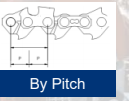
Measure from the center of one rivet to the center of the third consecutive rivet, then divide by two.
Pitch should not be estimated from cutter size or bar length. Cutter shapes vary within a pitch family, and more than one pitch may appear on saws with similar nominal bar lengths. The bar marking, chain identification and manual are more dependable than visual comparison.
Common Pitch Families: 1/4, .325, 3/8 and .404
| Pitch family | Where it may be encountered | Important distinction |
|---|---|---|
| 1/4 inch | Compact pruning and specialized lightweight cutting systems | Gauge and drive-link count still vary by equipment |
| .325 inch | Many general-purpose and professional saw configurations | Do not treat .325 as interchangeable with 3/8 |
| 3/8 low profile | Compatible lightweight and homeowner-oriented cutting systems | It is a different system from standard 3/8 chain |
| Standard 3/8 inch | A broad range of forestry and general cutting setups | Requires the matching standard bar and sprocket system |
| .404 inch | Compatible heavy-duty and specialized cutting equipment | Selection must follow the saw and cutting-attachment specification |
Pitch notation can appear as a fraction or a decimal. The label 3/8 represents three-eighths of an inch, while .325 and .404 are written as decimals. The notation is a product-family name and should be copied exactly into an order. Converting the label mentally or rounding it to a nearby value can create confusion, especially when several chain families are stored together. Keep each pitch in a clearly identified package and confirm the marking before installation.
These application descriptions are orientation, not fit rules. A saw’s power, sprocket, guide bar and approved cutting system determine which pitch it can use. Never move to a larger or smaller pitch simply because the work seems lighter or heavier.
.325-inch chain
The .325 chainsaw chain family is available in different gauges, cutter styles and drive-link counts. The decimal is a pitch designation. It does not mean the gauge is .325 inch, and it does not specify the length of the loop.
3/8-inch chain
Standard 3/8 chainsaw chain must be distinguished from 3/8 low profile. The names share a nominal pitch, but their component geometry and compatible cutting systems are not automatically interchangeable. The complete product designation matters.
.404-inch chain
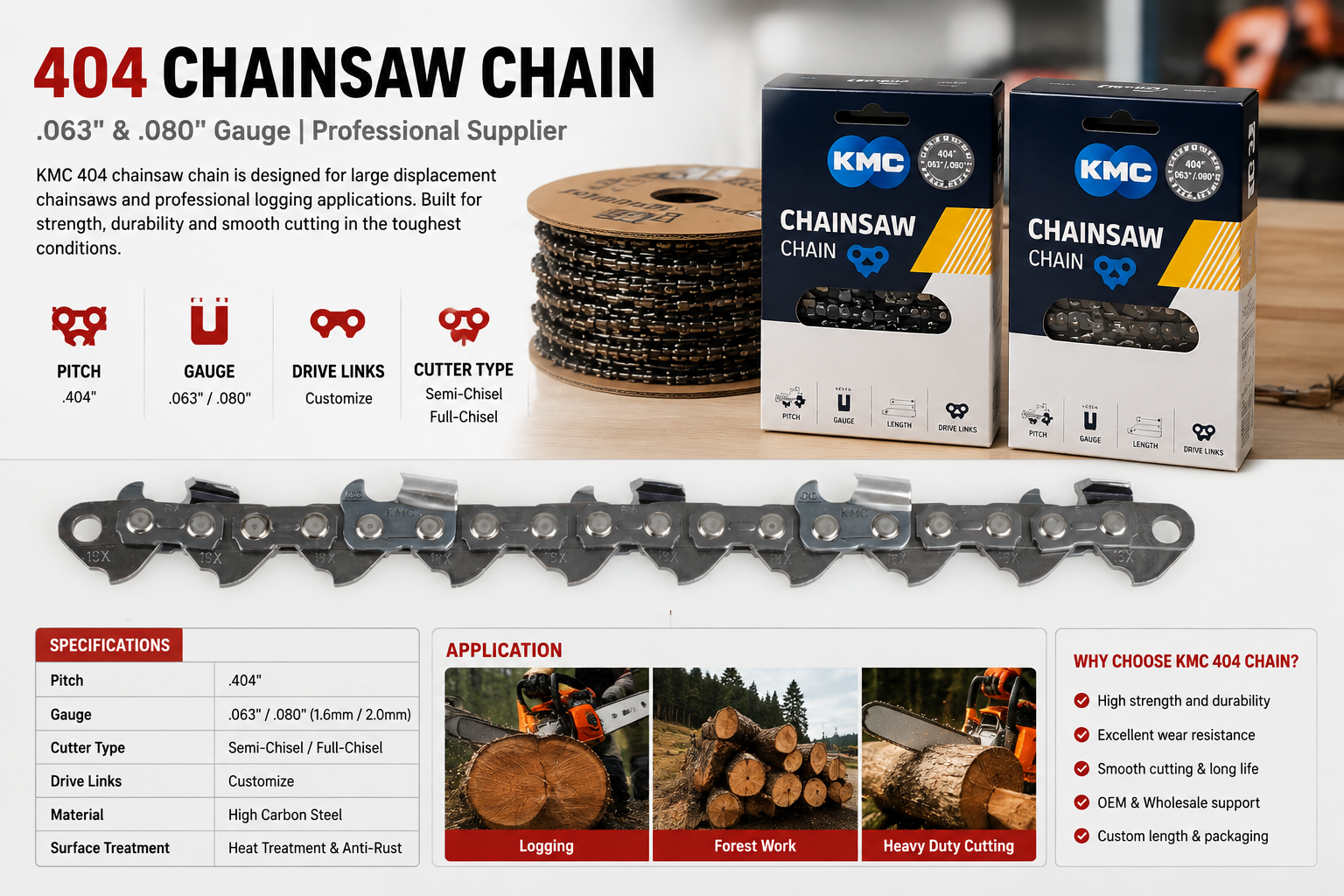
The .404 chainsaw chain family is associated with compatible heavy-duty equipment and specialized applications. It should be selected from the machine and bar specification, not as a general upgrade for a smaller-pitch system.
How to Identify the Pitch Correctly
The quickest method is to find the information already provided with the cutting attachment. Look for a marking on the guide bar, the equipment manual, the original chain package or an identification chart for the exact bar and saw combination. A marking may list pitch together with gauge and drive links.
If the markings cannot be read, clean the chain and select three consecutive rivets. Measure from the center of the first rivet to the center of the third. Divide that distance by two and compare the result with recognized chain-pitch dimensions. A worn or dirty chain can make casual measurement difficult, so use a suitable measuring tool and avoid guessing between close-looking results.
Disconnect or isolate the power source according to the saw instructions.
Wear gloves and place the chain on a stable surface.
Select three consecutive rivets that are easy to see.
Measure center to center from the first to the third rivet.
Divide the measurement by two.
Confirm the result against the guide bar, sprocket or equipment documentation.
Measuring the pitch does not complete the identification. Record gauge and drive-link count before selecting a replacement. If the saw has been fitted with a different bar from its original configuration, identify the components that are actually installed.
Why the Wrong Pitch Does Not Fit
The drive sprocket pulls the chain by engaging the drive links at repeated intervals. When the intervals do not correspond, the chain cannot seat and articulate around the sprocket correctly. The guide-bar nose sprocket, when present, must also match the chain pitch.
A wrong-pitch chain may be obviously impossible to install, or a user may be tempted to force components together because the loop looks close in size. Forcing the chain, changing tension to compensate or mixing incompatible parts is not a valid installation method. Stop and verify the cutting system.
Changing pitch normally means more than buying a different loop. A complete conversion, when allowed by the saw maker, can require a matching drive sprocket, guide bar and chain. The equipment documentation should determine whether such a configuration is permitted. Without that approval, retain the specified pitch.
Do not select pitch by cutter appearance.
Do not assume all chains for the same bar length share a pitch.
Do not confuse 3/8 low profile with standard 3/8.
Do not alter drive links or sprockets to make a chain engage.
Do not use tension adjustment to compensate for incompatible components.
How Pitch Works with Gauge and Drive-Link Count
Pitch answers the sprocket-spacing question. Gauge answers the bar-groove-width question. Drive-link count answers the loop-length question. All three must be correct at the same time.
| Field | Must match | A mismatch can cause |
|---|---|---|
| Pitch | Drive sprocket and bar-nose system | Failure to engage or articulate correctly |
| Gauge | Guide-bar groove | A chain that will not enter the groove or is inadequately supported |
| Drive links | Required loop length for the bar | A loop that is too short to install or too long to tension correctly |
Once these fit specifications are fixed, the buyer can choose a suitable cutter profile, sequence and application design. A full specification may read as pitch + gauge + drive links + cutter style. The complete chainsaw chain specification guide explains how those fields work together.
Frequently Asked Questions
How do I calculate chainsaw chain pitch?
Measure from the center of one rivet to the center of the third consecutive rivet, then divide the distance by two. Whenever possible, confirm the result with the guide-bar marking or equipment manual before ordering a replacement.
Is .325 pitch the same as 3/8 pitch?
No. They are different pitch families and require corresponding cutting-system components. A .325 chain should not be installed on a 3/8 sprocket and bar system, or the reverse, unless the equipment maker specifies a complete compatible conversion.
Are 3/8 and 3/8 low-profile chains interchangeable?
No automatic interchangeability should be assumed. They are different chain systems despite sharing a nominal pitch description. Confirm the complete chain family, gauge, drive-link count, bar and sprocket before replacement.
Can two chains have the same pitch but different sizes?
Yes. Chains with the same pitch may have different gauges and drive-link counts, as well as different cutter profiles or sequences. Pitch identifies only one dimension of the complete chain specification.
Can I determine pitch from the guide-bar length?
No. Nominal bar length does not uniquely determine pitch. Bars of a similar length may use different sprocket, gauge and chain configurations. Read the markings or documentation for the actual cutting attachment.
Conclusion: Chainsaw chain pitch identifies how the chain matches the drive sprocket and bar-nose system, but it cannot identify a replacement by itself. Measure across three rivets and divide by two only when reliable markings are unavailable. Then verify gauge and drive-link count before considering cutter style or application.
For assistance confirming a pitch family, send KMC the guide-bar markings, saw model and current drive-link count before ordering.