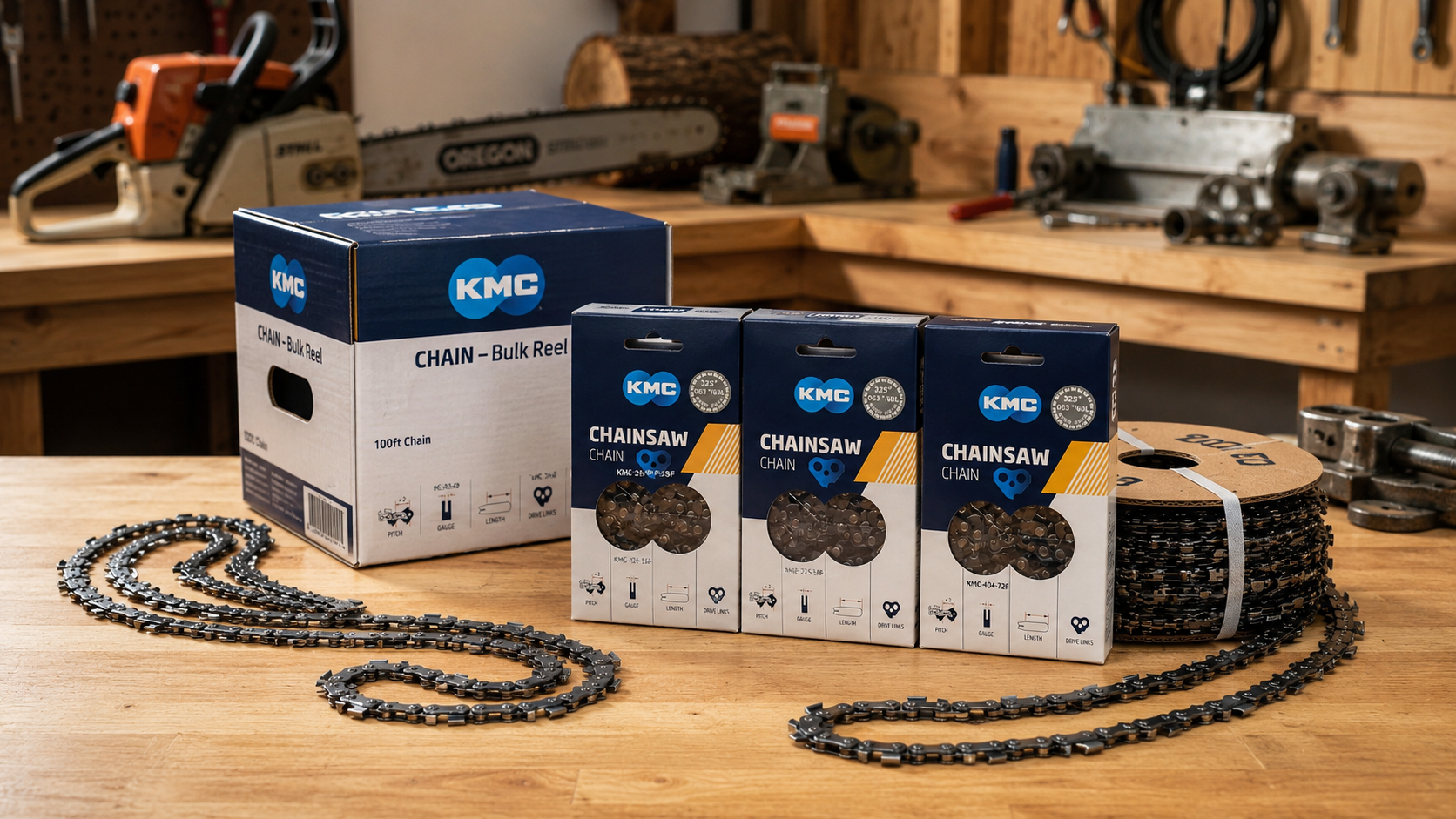
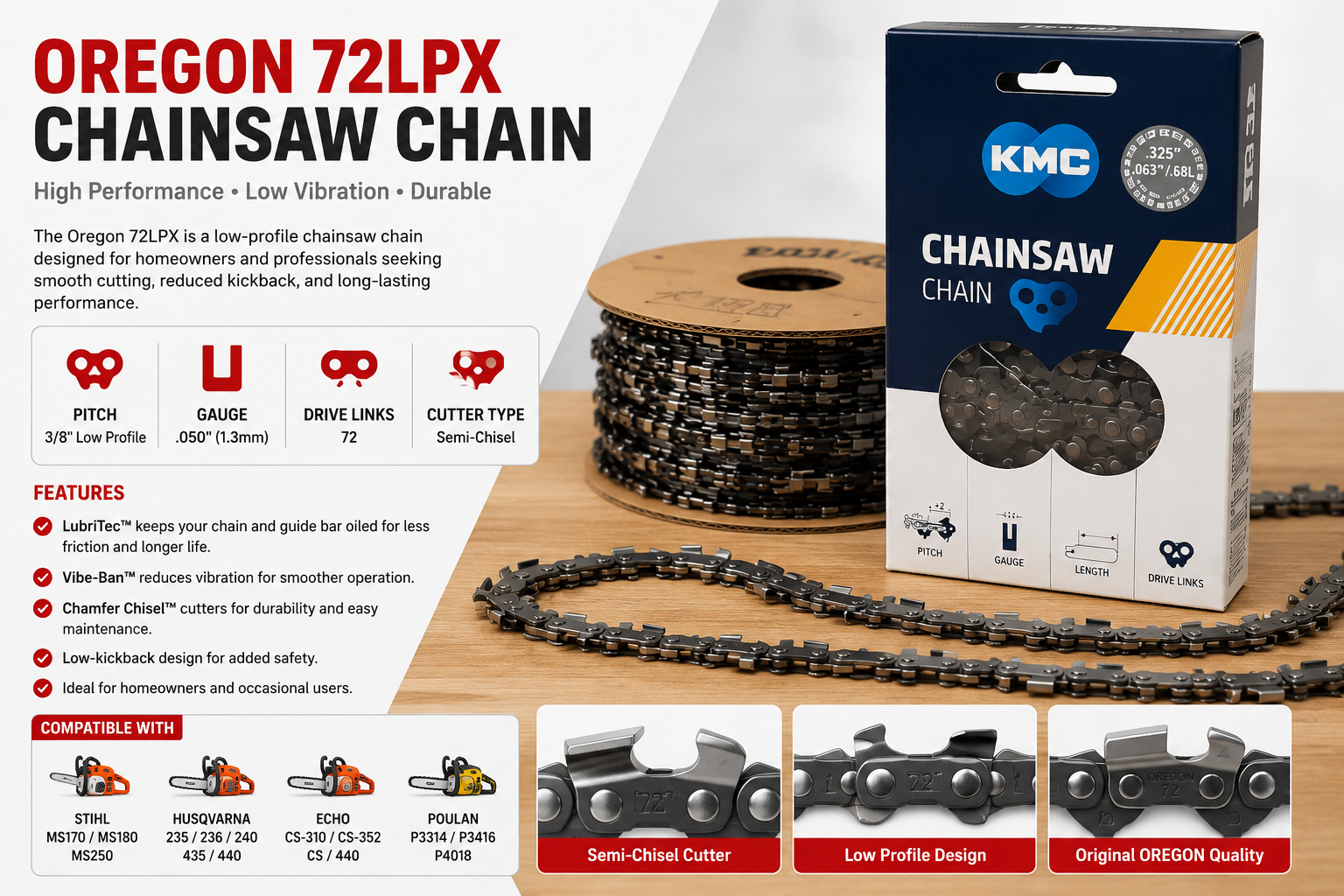
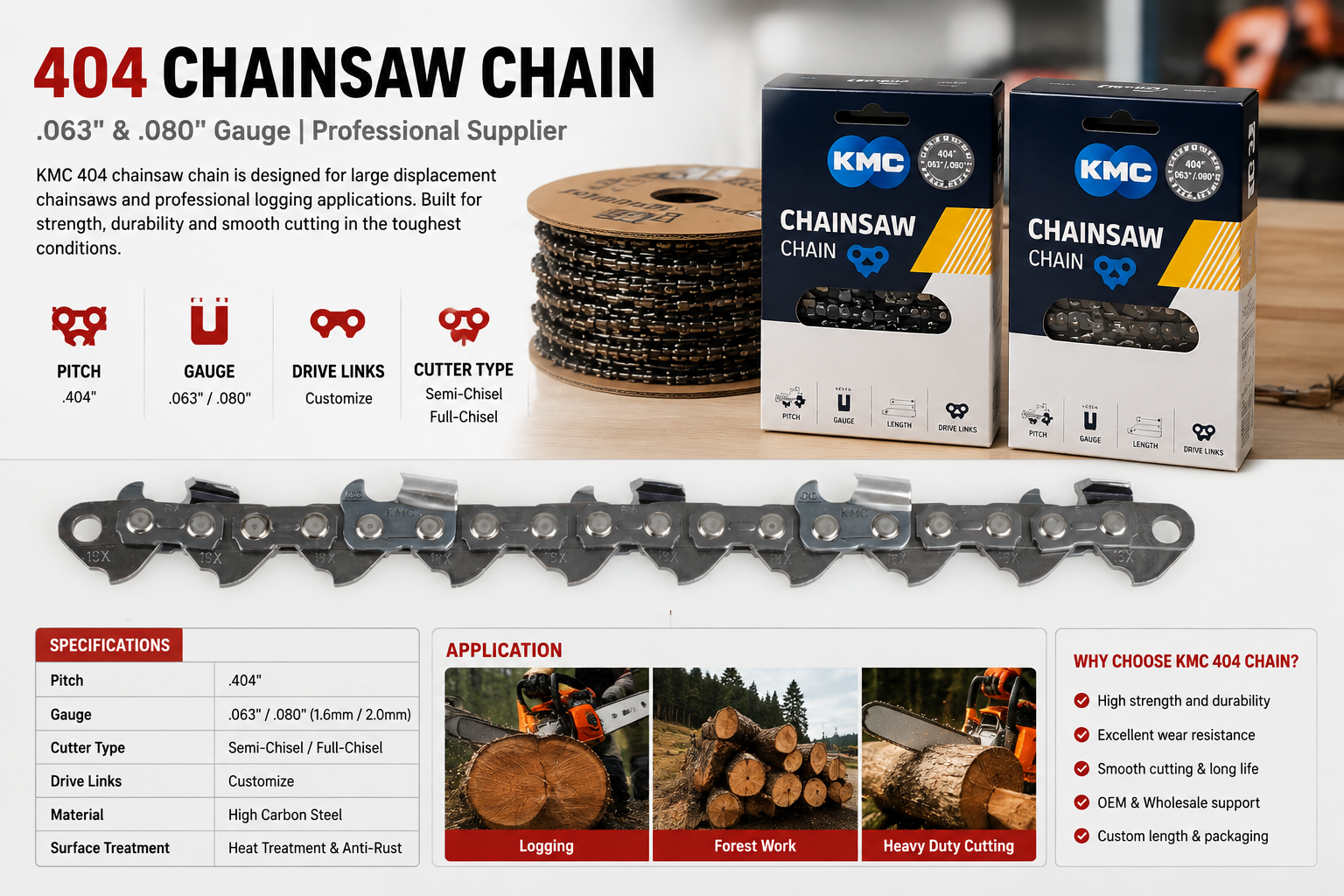
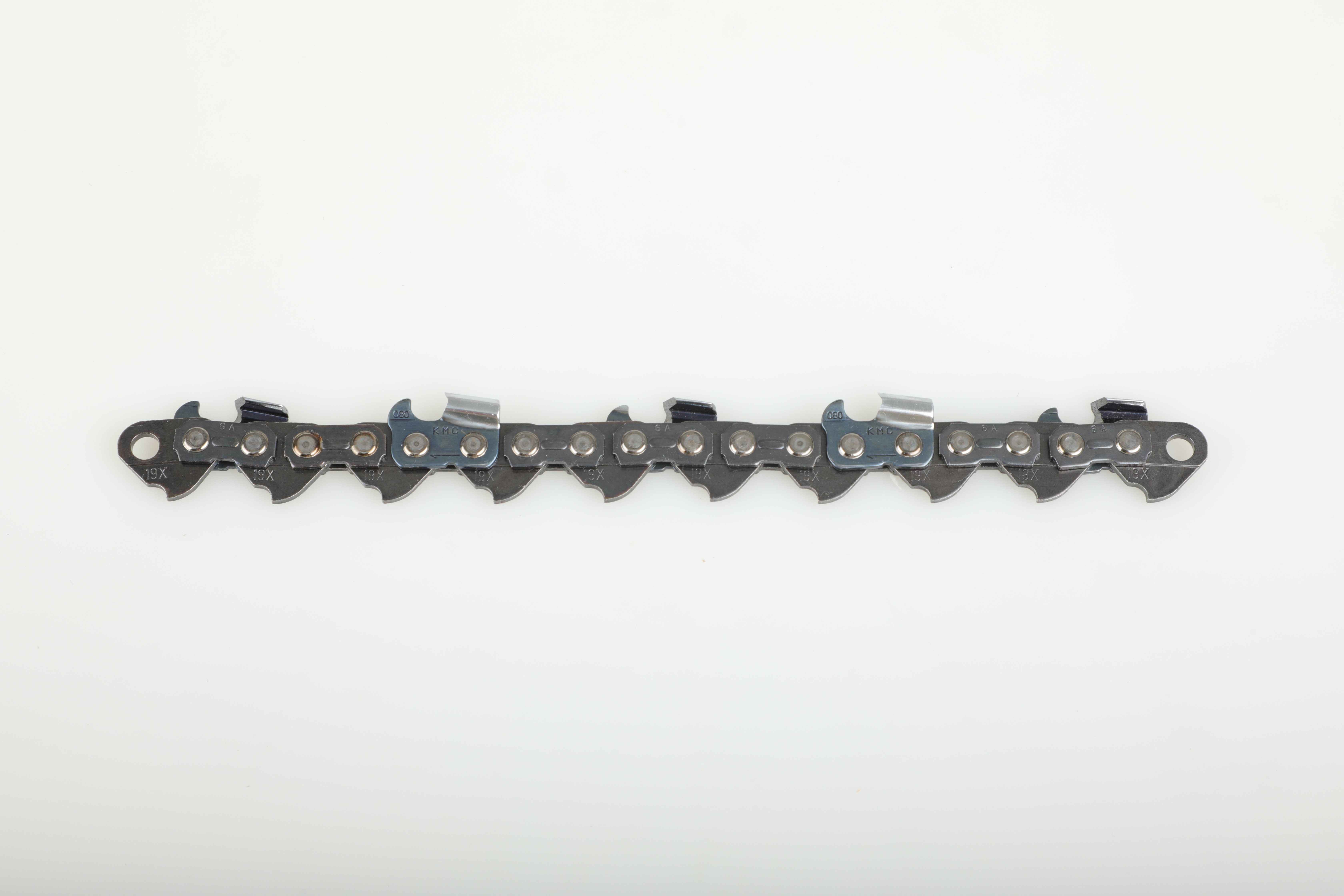
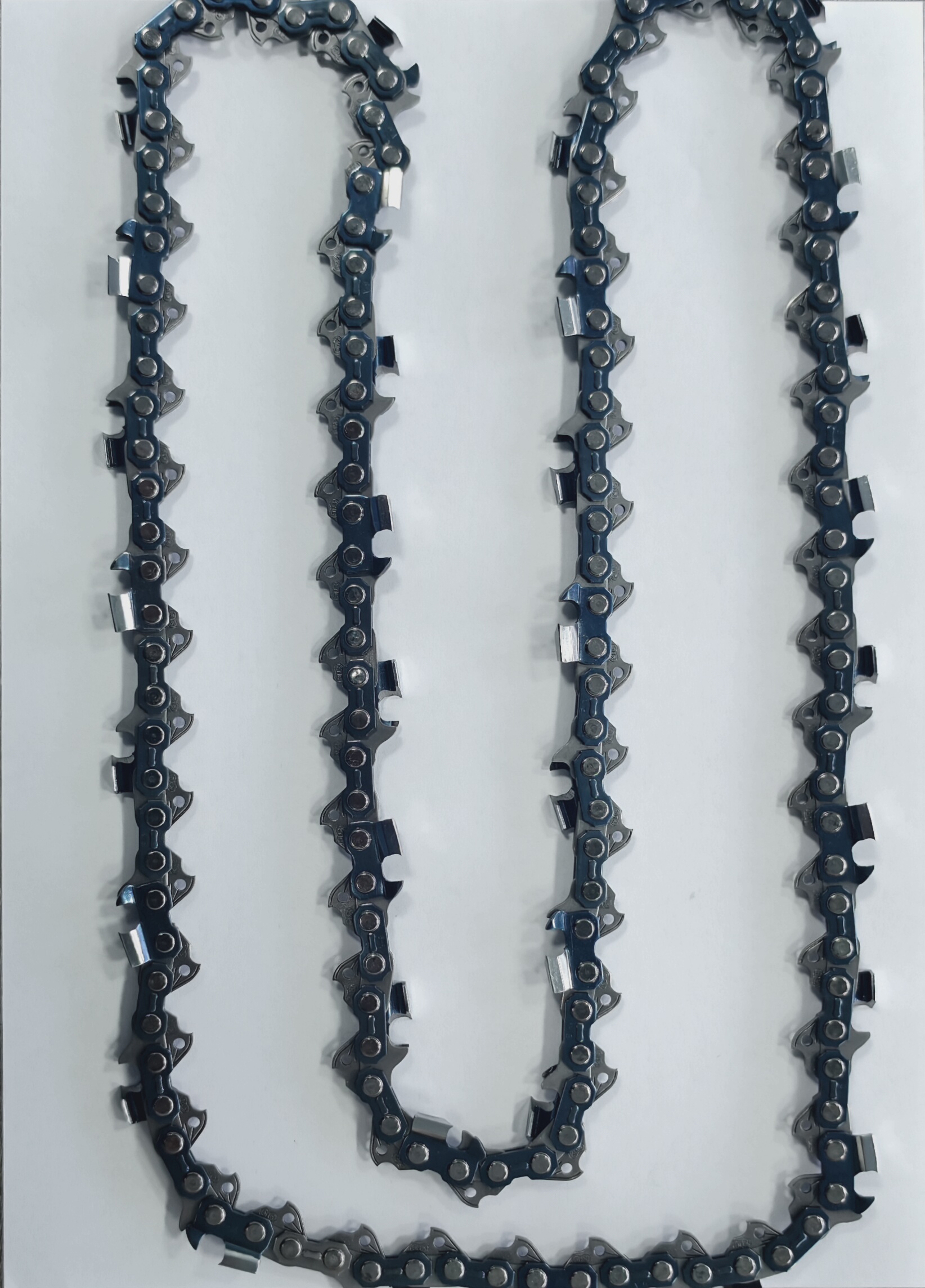
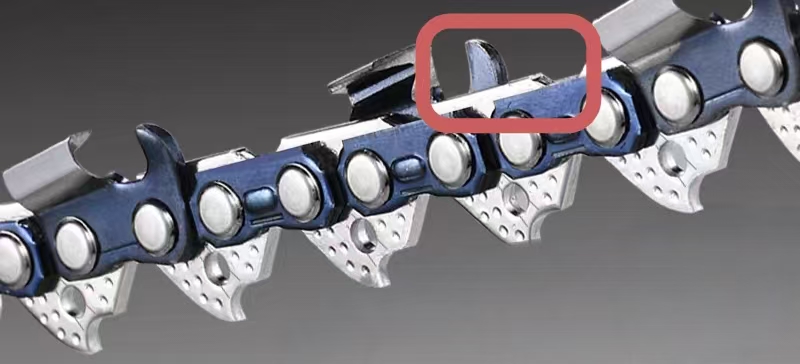
The classification of chainsaw chains is easier to understand when every chain is viewed through the same four questions: What shape is the cutter? How are the cutters arranged? Is the chain low profile or standard profile? What pitch, gauge and drive-link count make it fit the saw? These categories describe different parts of the same chain, so a product can belong to several classifications at once.
For example, a chain may be a semi-chisel, full-complement, 3/8-inch low-profile chain with a .050-inch gauge. Each term answers a separate selection question. The classification is useful only when the terms are combined with the specifications stamped on the guide bar or listed in the chainsaw manual.
Classification of Chainsaw Chains at a Glance
Cutter profile: full chisel, semi chisel and other specialized cutter shapes.
Cutter sequence: full complement, semi skip and full skip.
Chain profile: low-profile or standard-profile construction.
Dimensions: pitch, gauge and drive-link count.
Application: pruning, firewood, landscaping, farm work, forestry or demanding logging.
Classification begins with the cutter profile because the working corner of the cutter has a direct influence on cutting behavior. It does not, however, replace the fit specifications. Two chains with the same cutter shape can have different pitch or gauge and cannot automatically be interchanged.
Chainsaw chains can share a cutter style while differing in pitch, gauge, drive links and intended use.
Classification by Cutter Profile and Sequence
Full chisel cutters
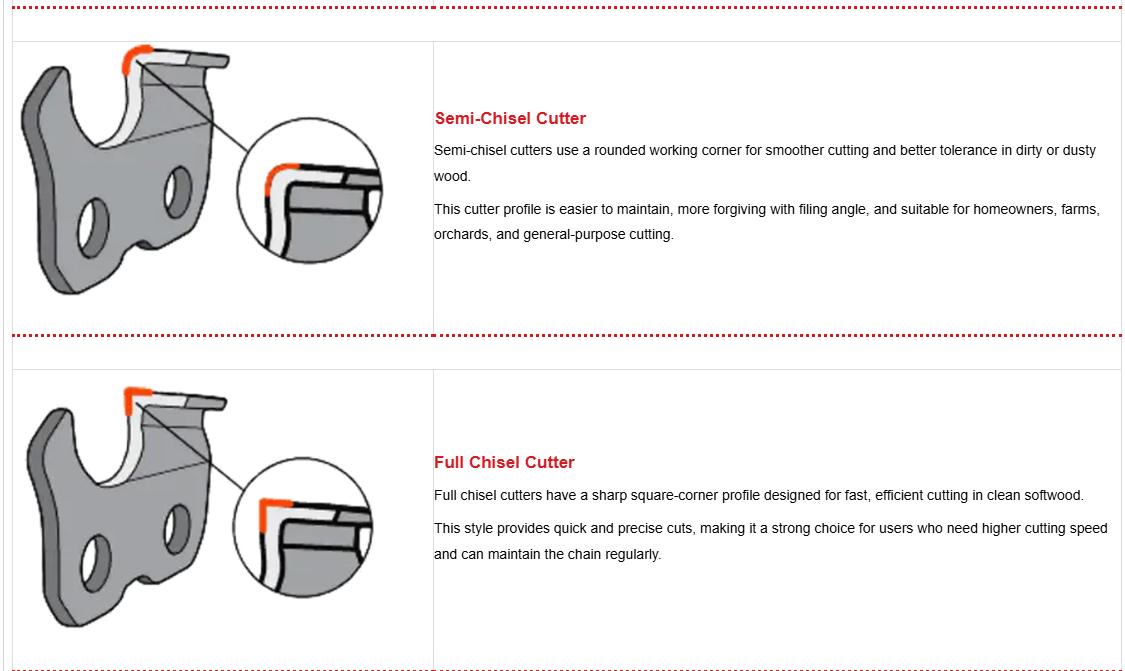
Full chisel cutters have a more angular working corner. They are selected when fast cutting in relatively clean wood is the priority and the operator is prepared to maintain a precise cutting edge. This profile is commonly associated with professional work, but the chain still has to match the saw, guide bar and operating conditions.
The sharper corner can lose its effective edge sooner when it contacts soil, dirty bark or embedded debris. A full chisel chain is therefore not automatically the best choice for every powerful saw. It is a classification based on cutter geometry, not a promise that the chain will outperform every other design in every type of wood.
Semi-chisel cutters
Semi-chisel cutters use a more rounded working corner. The shape generally makes the cutting edge more tolerant of mixed conditions and easier to maintain for users who value predictable performance. It is widely used for firewood, farm maintenance, landscaping and forestry work where the timber may not remain perfectly clean.
Semi chisel should not be confused with a low-profile chain. A standard-profile professional chain can use semi-chisel cutters, and a low-profile chain may also use a rounded cutter shape. One term describes the cutter; the other describes the overall profile and safety-oriented geometry.
Special-purpose cutters
Some chains are designed around special cutting tasks or equipment. These products should be selected from the manufacturer specification rather than identified only by appearance. When a buyer needs a chain for an unusual material, machine or cutting system, the safest purchasing method is to provide the complete chain specification and application to the supplier.
Cutter Sequence
Cutter sequence describes how many tie straps or spaces appear between cutting teeth. The sequence changes the number of cutters working around the loop and can affect chip clearance, smoothness, maintenance time and the way a long chain behaves in a large cut.
| Sequence | Basic arrangement | Typical reason for selection |
|---|---|---|
| Full complement | Standard cutter spacing | Balanced, smooth cutting on many common bar lengths |
| Semi skip | A mixed spacing pattern | A compromise between cutter count and chip space |
| Full skip | More space between cutters | Longer cutting attachments and applications needing more chip clearance |
A skip sequence is not a shortcut for fitting a longer chain to a saw. Pitch, gauge and drive-link count still have to match exactly, and the saw must be suitable for the cutting attachment. Buyers should use the sequence specified for the machine and task rather than assuming that fewer cutters always mean faster cutting.
3. Low-Profile and Standard-Profile Chains
Low-profile chain is designed for compatible lightweight saws and pruning equipment. It usually combines a compact cutter and safety-oriented components intended to reduce the energy of a potential kickback event. The familiar 3/8 low-profile chainsaw chain range is a common example, but the phrase “3/8” alone does not identify a low-profile chain.
Standard 3/8 chain and 3/8 low-profile chain are separate product families. Even though the pitch name sounds similar, their component geometry and compatible cutting systems are not automatically interchangeable. A buyer should verify the exact chain family along with gauge and drive links before ordering.
Standard-profile chains cover a broad range of professional and general-purpose applications. They may use full chisel or semi-chisel cutters and may be available in different sequences. Profile should therefore be treated as one line in the specification, not as a complete product description.
4. Classification by Pitch, Gauge and Drive Links
Dimensional classification determines fit. Pitch relates to the spacing of the chain’s riveted components and must match the drive sprocket and bar nose. Common product families include .325 chainsaw chain, standard 3/8 chainsaw chain and .404 chainsaw chain. These labels identify a pitch family, not a complete replacement-chain size.
Gauge is the thickness of the drive link where it runs in the guide-bar groove. It must match the groove so the chain is supported correctly. Drive-link count determines the loop length for the specific guide bar. Two chains can share the same pitch and gauge but have different drive-link counts, so they are not the same size.
Read the pitch marking on the guide bar or in the manual.
Confirm the gauge rather than estimating it visually.
Record the drive-link count for the exact bar and saw combination.
Then select cutter profile, sequence and application features.
This order prevents a common purchasing error: choosing a chain by bar length or cutter name before checking the three dimensions that control fit.
Classification by Application and Ordering
| Application | Useful classification questions | Selection priority |
|---|---|---|
| Pruning and light yard work | Is the saw designed for low-profile chain? | Correct fit, manageable behavior and easy maintenance |
| Firewood and farm maintenance | Will the wood be clean, wet or dirty? | Durability and practical sharpening |
| Professional forestry | Which cutter and sequence suit the bar and timber? | Productivity without compromising compatibility |
| Large-log cutting | Is the complete saw system approved for the selected chain? | Matching saw, sprocket, bar, chain and operator capability |
Application labels help narrow a product range, but they do not replace the machine specification. “Logging chain,” for example, can describe several cutter profiles, pitches and gauges. The correct option is the one that satisfies both the work requirement and every fit dimension.
How to Describe a Chain When Ordering
A clear order description should move from fixed specifications to preferences. Start with pitch, gauge and drive links. Add cutter profile and sequence. Then explain the wood condition, saw type, bar length and expected work. For wholesale or private-label projects, include packaging, identification and assortment requirements only after the technical chain specification is confirmed.
Required fit: pitch + gauge + drive-link count.
Cutting preference: full chisel or semi chisel.
Sequence: full complement, semi skip or full skip when applicable.
Profile: low profile or standard profile.
Application: pruning, firewood, landscaping, forestry or logging.
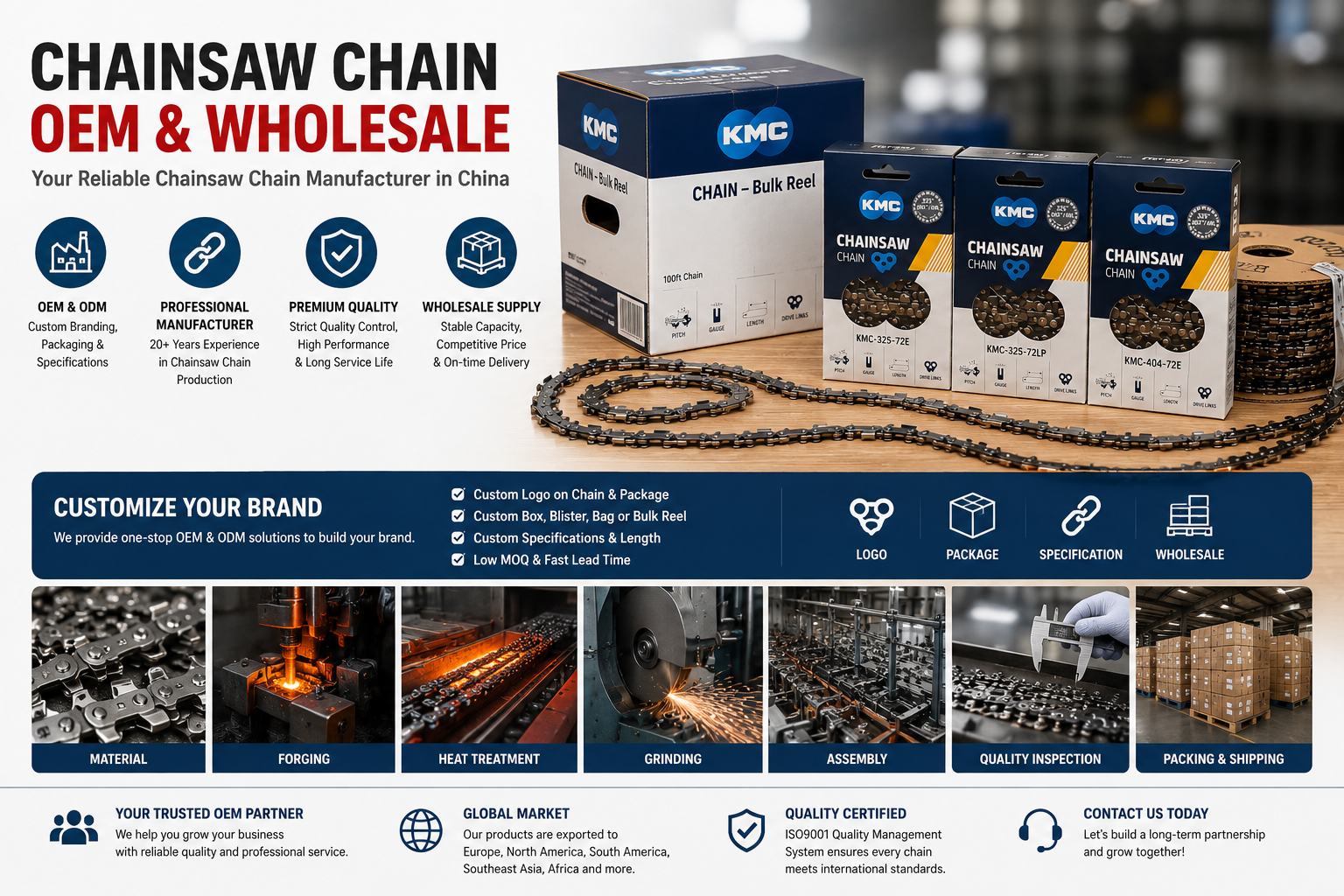
Buyers comparing several series can start with the complete KMC chainsaw chain product range. Distributors that require branding, mixed specifications or packaging support can review the OEM and wholesale chainsaw chain service after building a complete specification list.
Frequently Asked Questions
What are the main classifications of chainsaw chains?
The main classifications are cutter profile, cutter sequence, low or standard profile, pitch, gauge, drive-link count and intended application. A complete chain description normally combines several of these categories because no single label identifies both cutting behavior and physical fit.
Is full chisel the same as full complement?
No. Full chisel describes the shape of the cutter’s working corner. Full complement describes the spacing and number of cutters around the chain loop. A chain can use full-chisel cutters in a full-complement, semi-skip or full-skip sequence when that configuration is offered for the application.
Is 3/8 low profile interchangeable with standard 3/8 chain?
No automatic interchangeability should be assumed. They belong to different chain systems even though both names contain 3/8. Confirm the saw, sprocket, guide bar, chain family, gauge and drive-link count before replacing one chain with another.
Can bar length identify the correct chain classification?
Bar length is useful context but is not enough to identify a replacement chain. Bars of the same nominal length may use different pitch, gauge or drive-link counts. Read the bar markings or manual and verify the complete size before ordering.
Which classification is best for wholesale purchasing?
There is no single best classification for every market. A wholesale assortment should reflect the saws, bar systems and cutting work common among its customers. Build the range from verified specifications, then add cutter styles and application options that meet those needs.
Conclusion
The classification of chainsaw chains becomes practical when cutter profile, sequence, chain profile and application are kept separate from the dimensions that control fit. Begin with pitch, gauge and drive links, then choose the cutter and sequence for the wood and working conditions. This method creates clearer orders, reduces size confusion and makes product comparisons more useful.
For help matching a chain family or planning an OEM assortment, contact KMC with the saw model, bar markings and required drive-link count. A complete specification is the best starting point for an accurate recommendation.