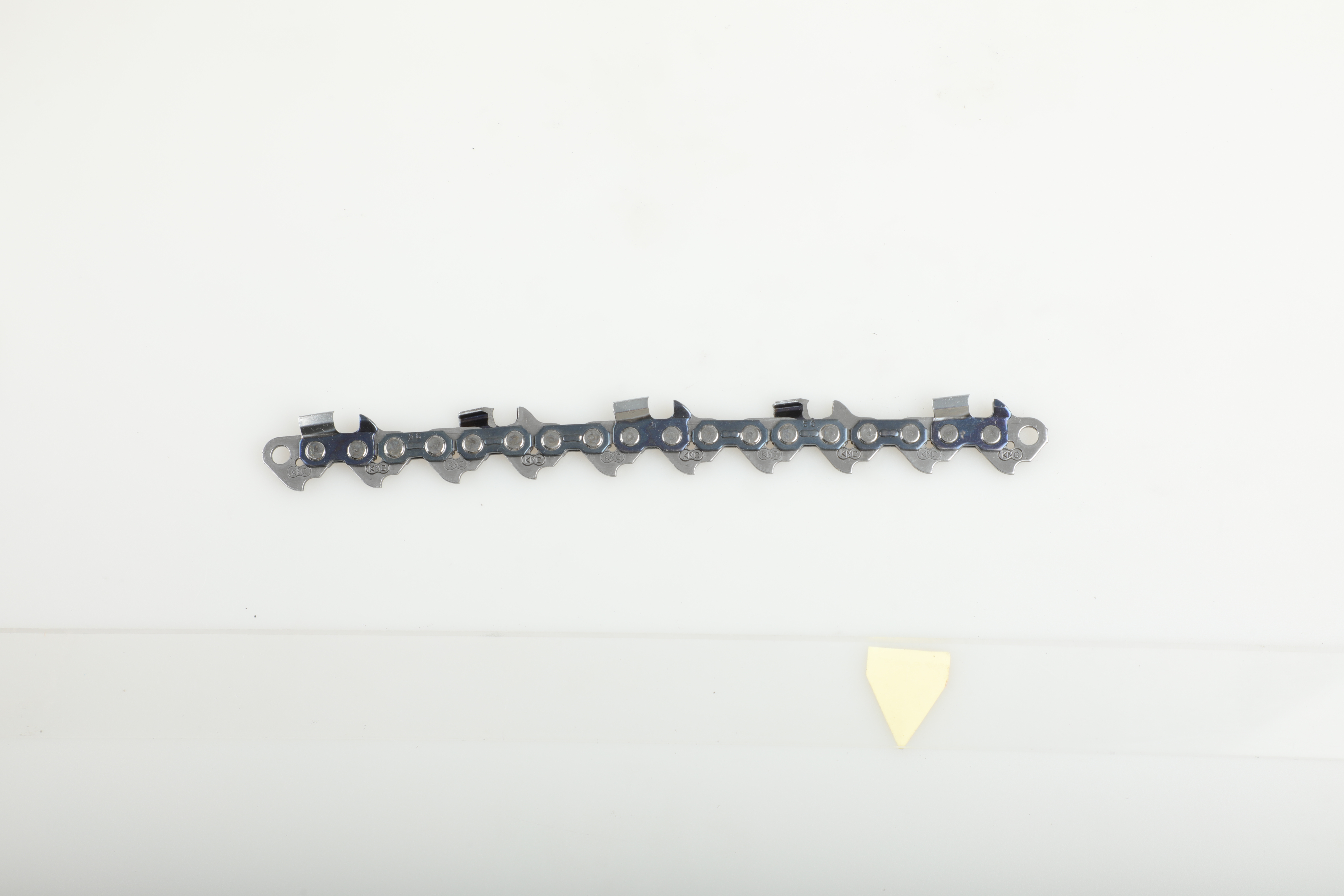
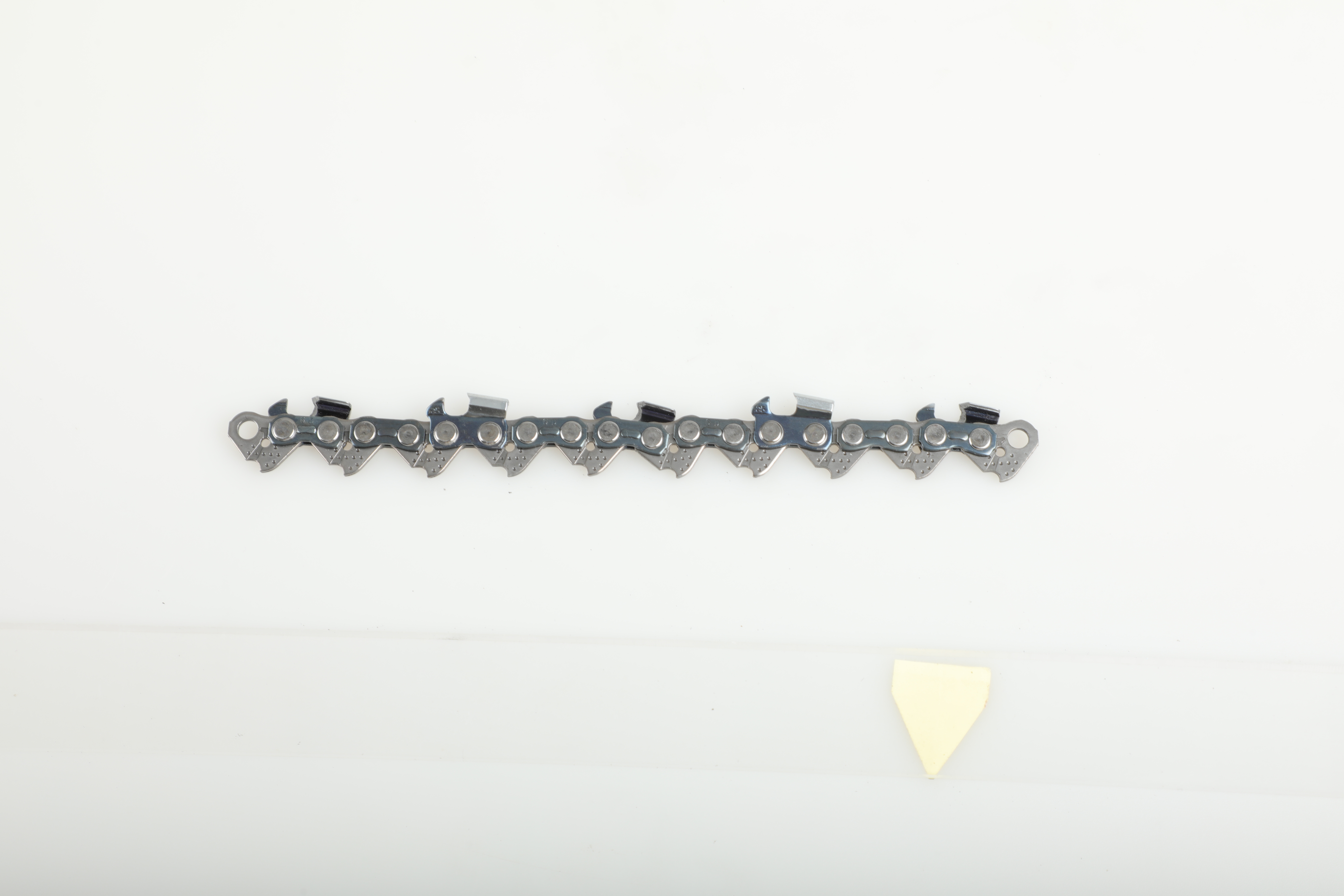
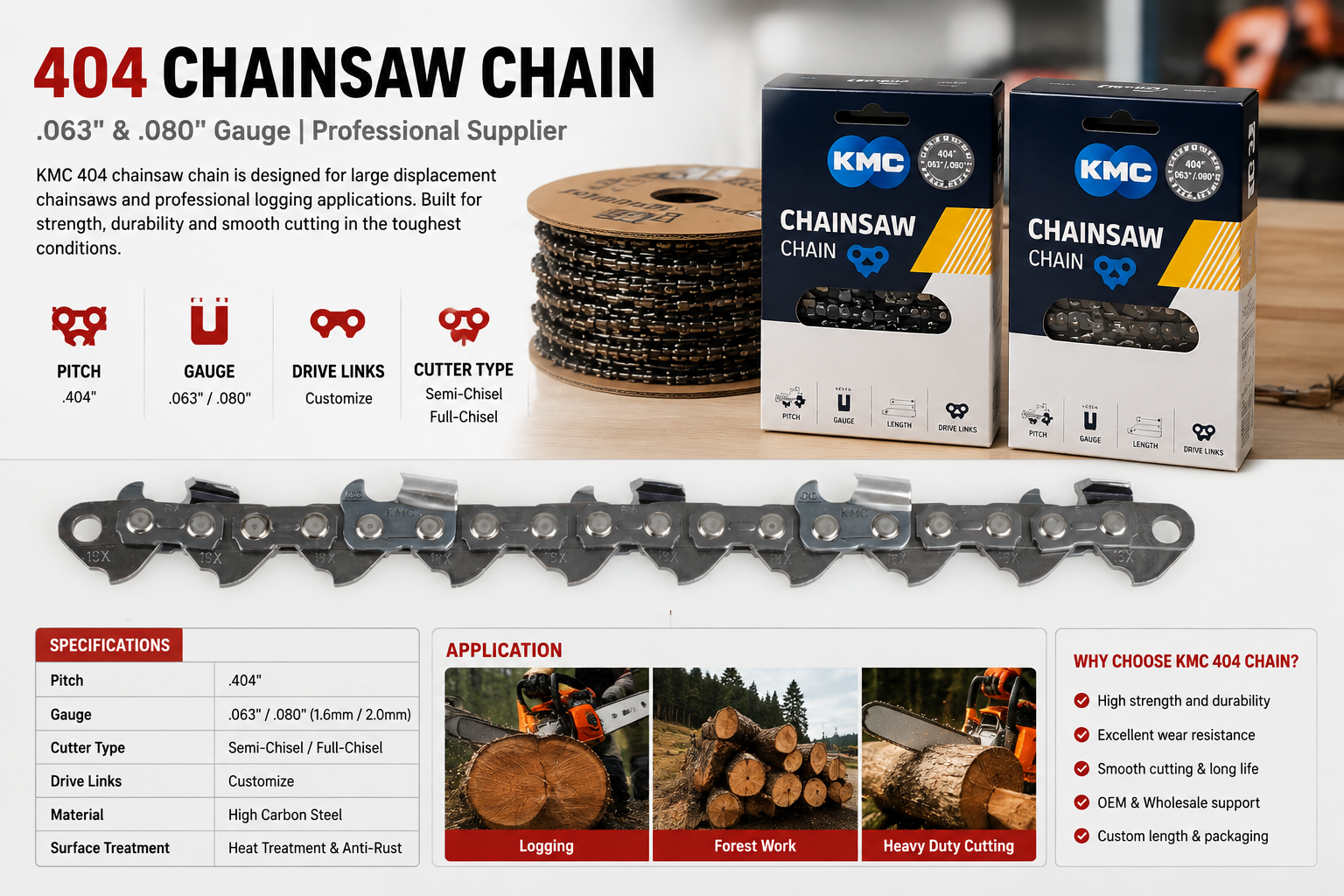
 A .404 chainsaw chain supplier may offer two products that share pitch but belong to different cutting systems. KMC publishes .404 .063 logging chain and .404 .080 harvester chain. A distributor must confirm gauge, drive-link count, cutter and application before comparing price or quantity. The shared .404 label—and even a shared 100 DL option—does not make the products interchangeable.
This comparison is for forestry distributors, logging-equipment dealers, harvester service networks and importers. Begin with the bar, sprocket and equipment documentation. Use the .063 route only where the applicable heavy handheld/logging attachment requires 1.6 mm gauge. Use .080 only where the mechanized cutting head requires 2.0 mm. Then build separate item, package and replenishment records.
A .404 chainsaw chain supplier should quote .063 and .080 on separate lines
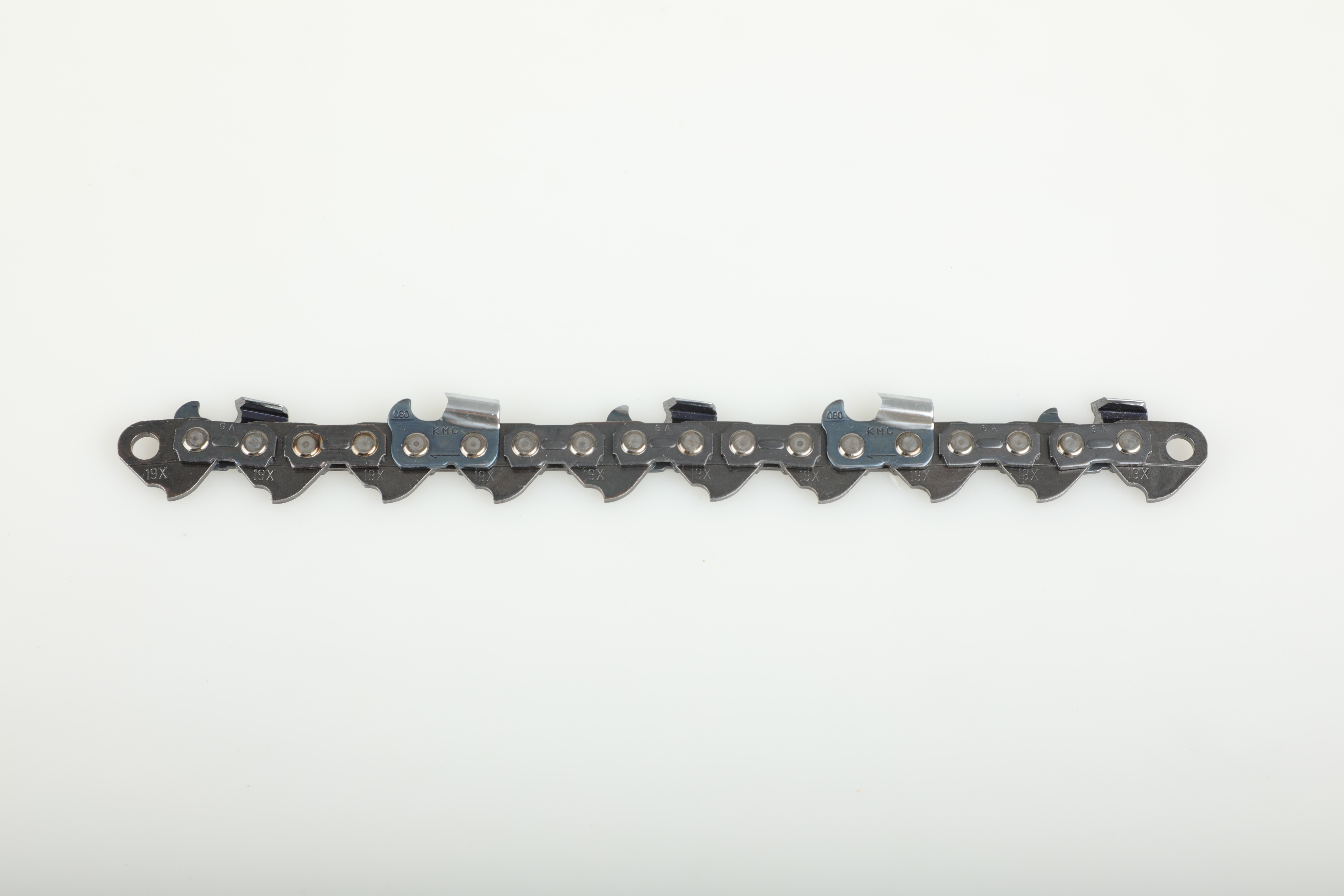
KMC’s .404 .063 product publishes 60, 92, 100 and 104 DL, semi-chisel or full-chisel cutters, and standard, semi-skip or skip sequences. The .404 .080 harvester product publishes 78, 80, 90, 91, 94, 95 and 100 DL with semi-chisel.
The quotation should repeat pitch, gauge, DL, cutter and sequence for every SKU. “.404 100 DL” remains ambiguous because both pages publish that count. A buyer who compares two unit prices without confirming the full lines may be comparing different products and packages.
.404 .063 supports cutter and sequence choices for logging applications
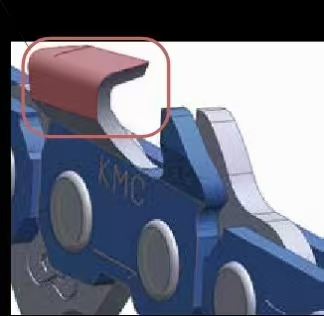
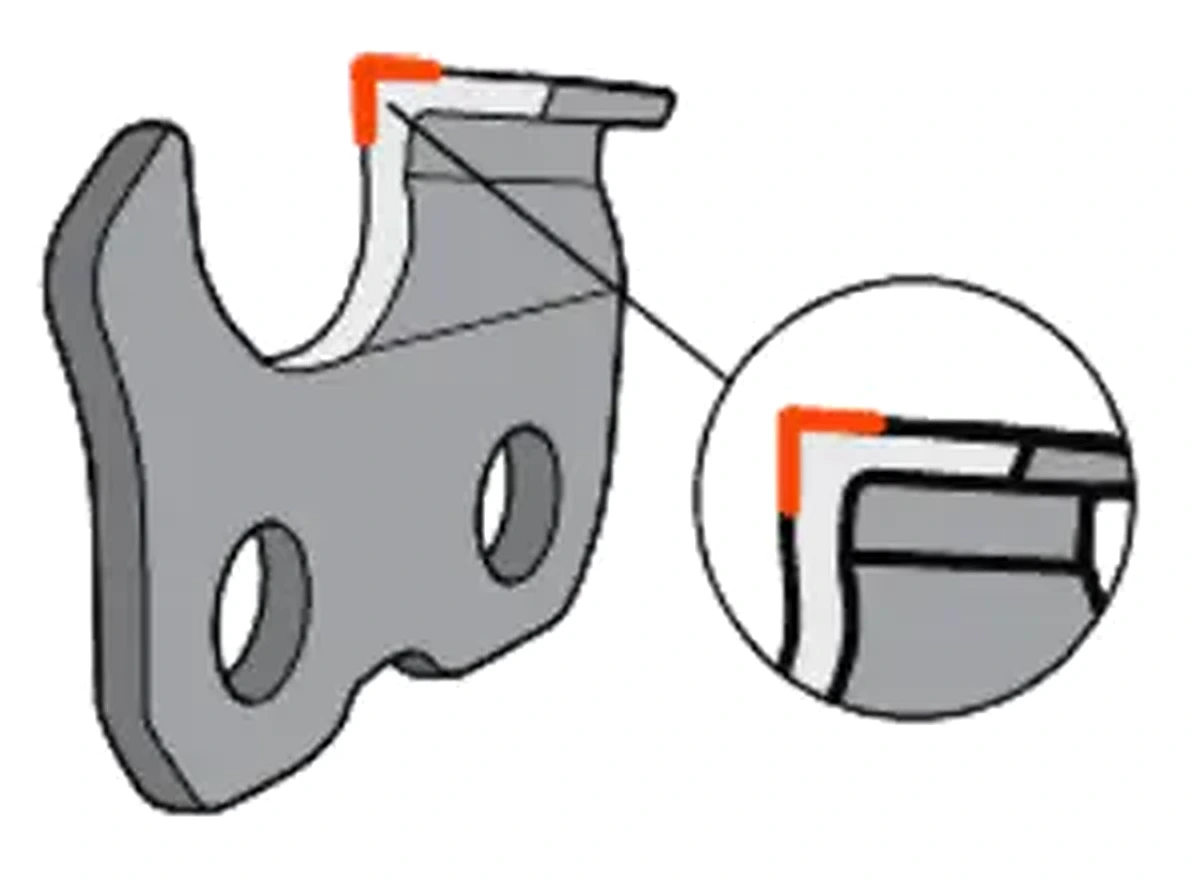
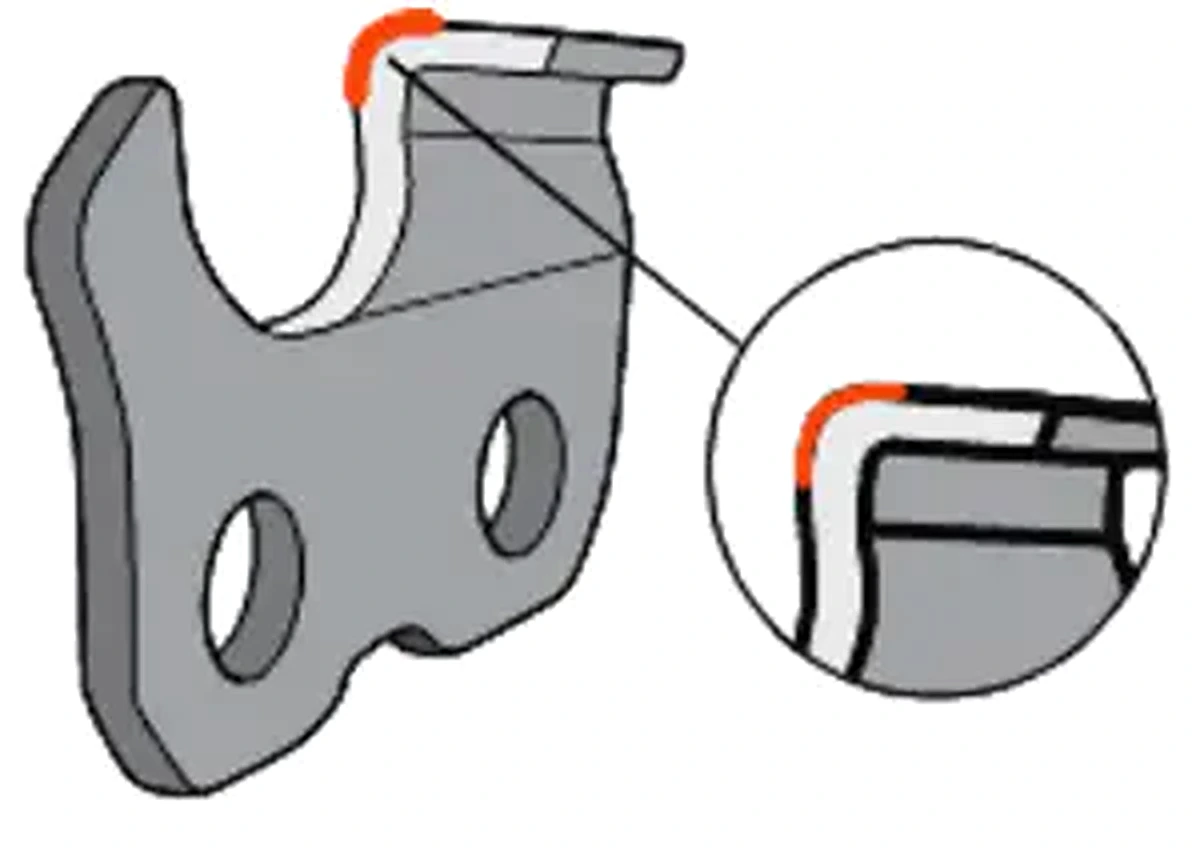
Semi-chisel has a rounded working corner and generally tolerates variable or contaminated wood better before dulling. Full-chisel has a sharper square corner for fast cutting in clean wood by experienced users. Standard, semi-skip and skip describe cutter spacing. The buyer selects these options according to the applicable saw, bar, power and work—not as a universal quality ladder.
.404 .080 belongs to the mechanized cutting-head record
The .080 product’s 2.0 mm drive link belongs in the matching harvester bar groove. Select 78–100 DL from the head/bar documentation. The KMC harvester replenishment guide explains how head-specific records follow the loop through depot and service truck.
Two buyer scenarios show why the shared pitch causes returns
A logging dealer adds .404 .063 beside 3/8 professional chain
The dealer serves applicable heavy saws and long-bar work. It confirms .404 .063 from the bar and sprocket system, then selects DL and cutter/sequence by its verified machine base. Unit labels show .404, .063/1.6 mm, DL, cutter and sequence. Staff do not select from bar length alone.
A 100 DL .063 full-chisel skip loop receives its own code. If semi-chisel standard is also stocked at 100 DL, the cutter and sequence remain visible. The dealer can train users on application differences without implying that one configuration fits every saw.
A harvester service network stores .404 .080 by cutting head
The network approves .404 .080 90, 94 and 100 DL for named heads and bars. Each service-truck bin shows head reference, .080/2.0 mm and DL. It never uses the .063 logging item as emergency stock, even when 100 DL matches.
The central depot scans issues by exact SKU. Consumption changes the next quantity but not the fitment identity. An urgent request for another head returns to technical review rather than the closest-looking loop.
Receiving should sample both sides of the 100 DL overlap
When one shipment contains .063 and .080, compare purchase order, packing list, carton, unit package and physical identity. Sample every high-risk SKU, including both 100 DL items. A correct outer carton does not prove that inner units carry the right gauge.
Warehouse locations should lead with gauge after .404
Arrange locations by .404–.063 and .404–.080 before DL. This mirrors the selection decision. Barcode screens and picking tickets should use the same hierarchy. Color may support recognition, but text remains essential when cartons are split or labels are copied.
A discrepancy belongs in a hold location with its exact SKU
If gauge is missing, DL is wrong or package and loop disagree, quarantine the units. Record supplier SKU, buyer SKU, carton and finding. Do not distribute ambiguous chain while asking the supplier a general question about the .404 family.
Packaging must keep the .404 gauge visible after carton splitting
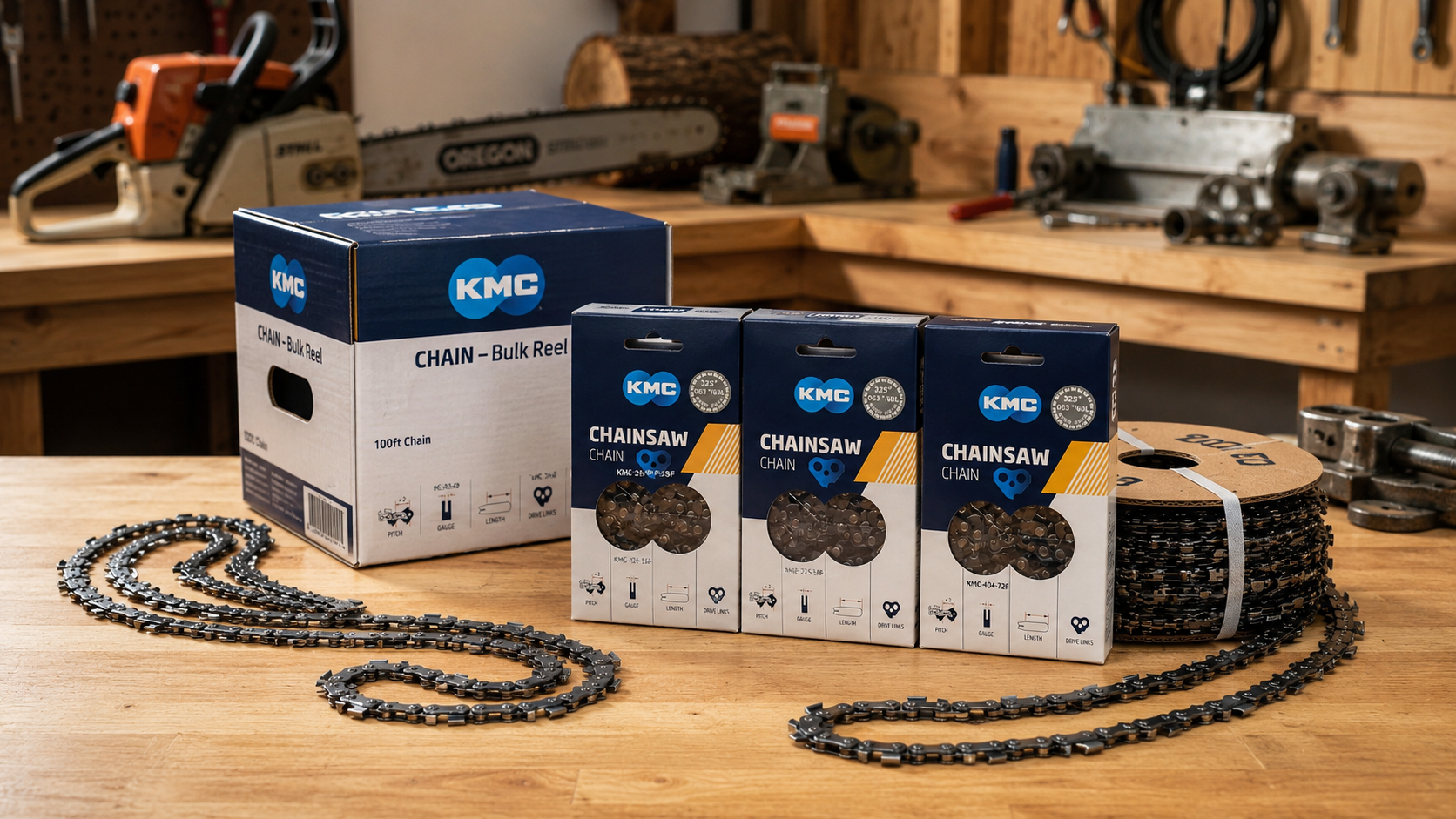
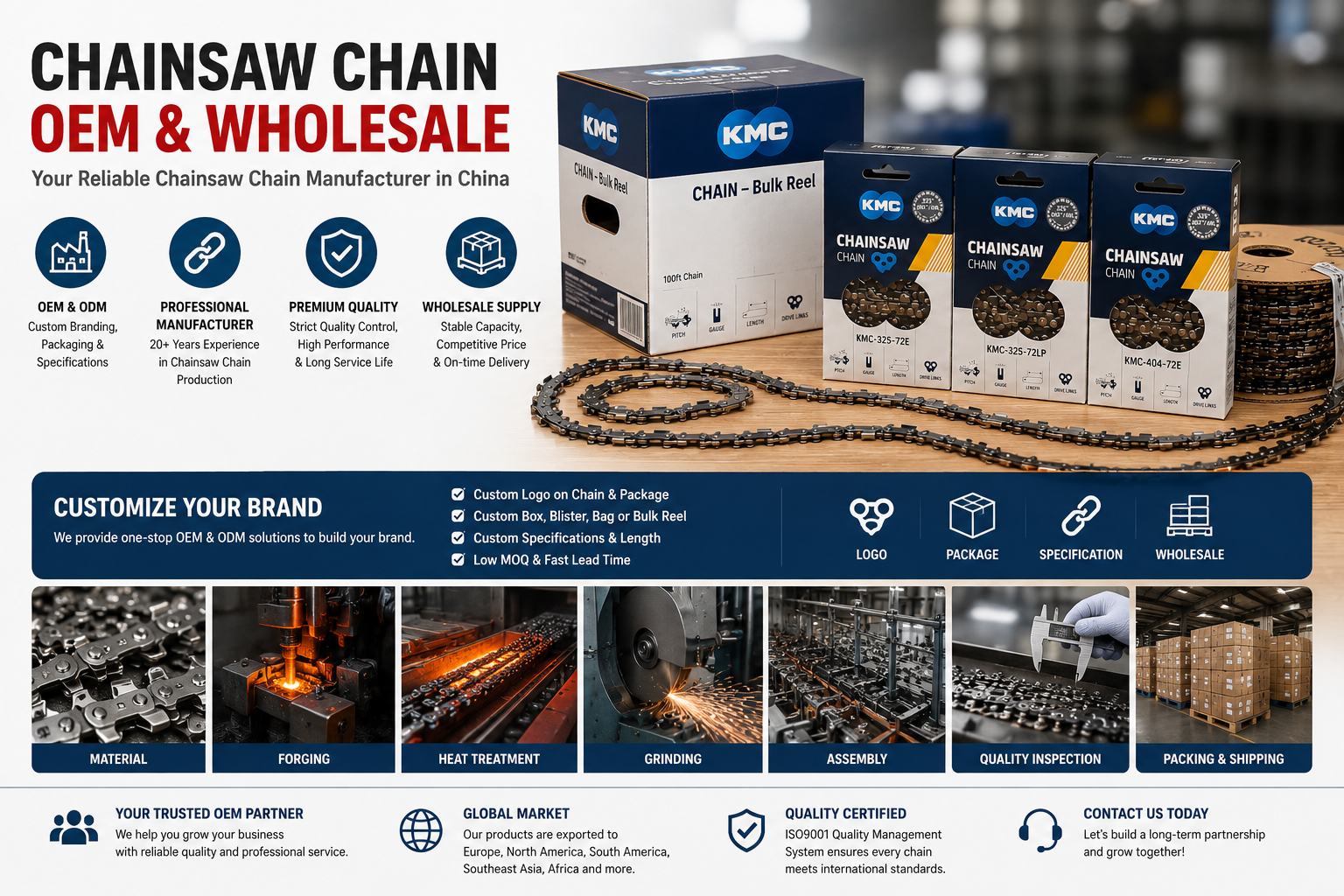
KMC’s OEM page publishes individual boxes, custom cartons, pallets and barcodes. Unit packs should show .404, gauge, DL, cutter/sequence where applicable and item code. Harvester head reference or compatible application can support the dimensions, not replace them.
One technical loop in two pack formats needs two commercial codes
A .404 .063 loop may be sold in a retail box and supplied to workshops in another approved format. Link both to the same technical record but assign distinct package codes and carton quantities. Sales can track the channel while technical returns trace to one loop.
Reorder .404 chain from the current item master
For every SKU, retain pitch, gauge, DL, cutter, sequence, application, package revision and accepted sample. Reorders draw from this master. Copying “.404 100 DL” from an old invoice drops the field that distinguishes logging from harvester use.
Review on-hand inventory and consumption separately for .063 and .080. A rising .080 issue rate does not justify reducing .063 safety stock unless the served machine base changed. Quantity follows demand; fitment follows the attachment.
Supplier samples should reproduce the exact commercial variants
Approve a tagged technical sample for each pitch-gauge-DL-cutter-sequence combination that will be sold. The .063 sample should name its applicable logging attachment and the selected cutter/sequence. The .080 sample should name its cutting head, bar reference and semi-chisel route. A single unlabelled .404 loop cannot approve both families.
Count the physical loop before approving its artwork
Compare the sample tag with the signed record, count the drive links and inspect the named cutter and sequence. Only then transfer the data to the retail or service package. If the count changes, reopen the barcode and artwork because the finished item changed even when the graphic layout did not.
Retain the accepted loop and one packed unit as controlled references. Mark them so they cannot enter sales stock. Replenishment inspection still remains lot-specific; the held references help detect an unintended change in a familiar item name.
Quality evidence should identify which .404 lot was reviewed
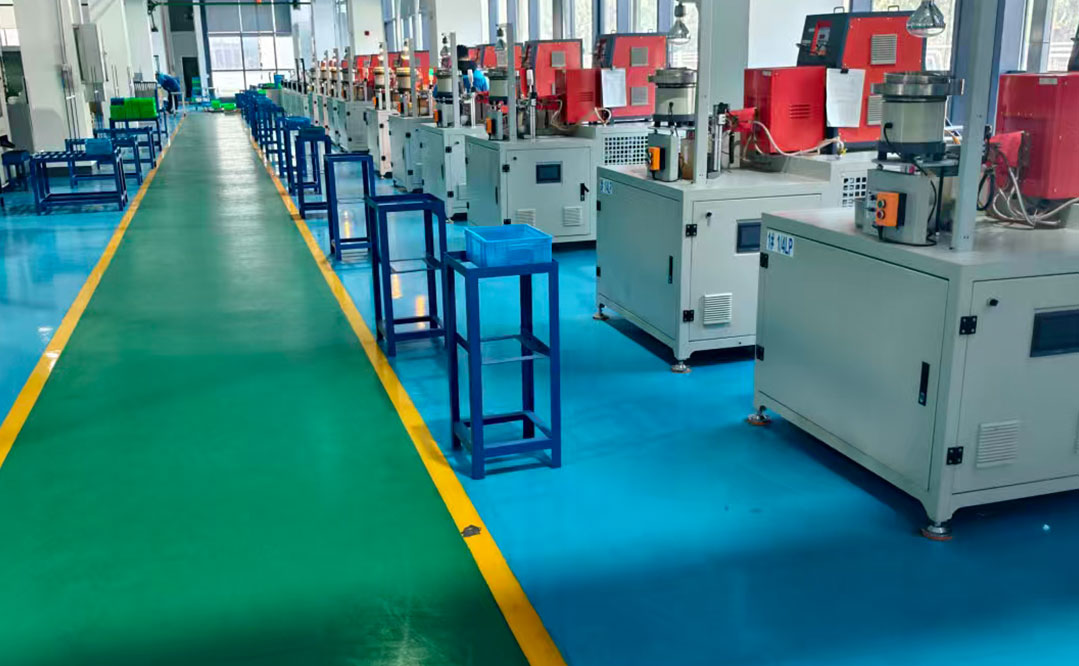
KMC states that its route includes material-composition inspection, heat-treatment and hardness control, automatic assembly, cutting tests and final inspection. A buyer should agree which records support first production and repeat orders. General factory photos or a report for another configuration do not release the ordered lot.
A mixed .063/.080 shipment needs separate first-piece checks
When production changes gauge, DL, cutter or sequence, compare the first completed loop with the correct order line before the run continues. Keep labels and in-process containers separated. Record the SKU and result so a later complaint can be connected to the relevant production window.
Sample cartons across each run under the agreed inspection plan. If a 100 DL .063 loop is packed under the .080 code, quantity and pitch may look correct while the product is unsafe for the intended groove. Gauge verification is therefore a direct release requirement.
Sales training should explain when each .404 route is not suitable
Staff should know that .404 .063 is not a universal heavy-chain choice and .404 .080 is not simply a stronger upgrade. Both require matching attachments. A customer who provides only bar length or machine power should be asked for bar, sprocket, gauge and DL evidence.
Do not turn cutter preference into a fitment claim
A customer may prefer semi-chisel for contaminated wood or full-chisel for clean cutting, but that preference comes after fitment. It cannot change .080 to .063 or choose a DL count. Sequence choices on .063 also depend on the applicable saw, bar, power and user route.
When staff cannot prove the cutting attachment, the correct outcome is a technical follow-up, not a sale from the nearest .404 bin. That boundary prevents urgent requests from becoming returns and gives the supplier a complete question to answer.
Complaint records should preserve package and attachment evidence
For a reported problem, retain the loop, unit package, lot or shipment reference and photographs. Record the saw or cutting head, bar, sprocket, lubrication, timber condition and observed issue. Separate fitment errors, foreign-object damage, maintenance conditions and suspected production defects before choosing corrective action.
Group claims by exact gauge and DL, not by the .404 family
If several reports involve .080 94 DL from one shipment, the supplier can examine a defined SKU and lot. Combining those with unrelated .063 100 DL complaints obscures the evidence. The buyer’s item master and package code should make the grouping possible.
After investigation, record the disposition and any change to stock, training or the approved specification. Do not overwrite the historical item silently. A controlled change log lets purchasing know which revision the next order must reference.
Review returns by exact SKU after each replenishment cycle and share the verified pattern with purchasing. A cluster of missing-gauge selections indicates a catalogue or counter problem; isolated damage on one cutting head may point to maintenance or operating conditions. The same data should never be used to make both conclusions without checking the evidence.
Choose the supplier that keeps both .404 routes unmistakable
The right .404 chainsaw chain supplier makes it easy for engineering, purchasing, receiving, sales and field service to identify the same loop. Verify .063 or .080 before DL, then preserve cutter, sequence and application through package and reorder.
Begin with the equipment record, not the shared pitch. When a selected packed unit can be traced back to the exact gauge and approved cutting system, the .404 range can grow without creating a warehouse of near matches.