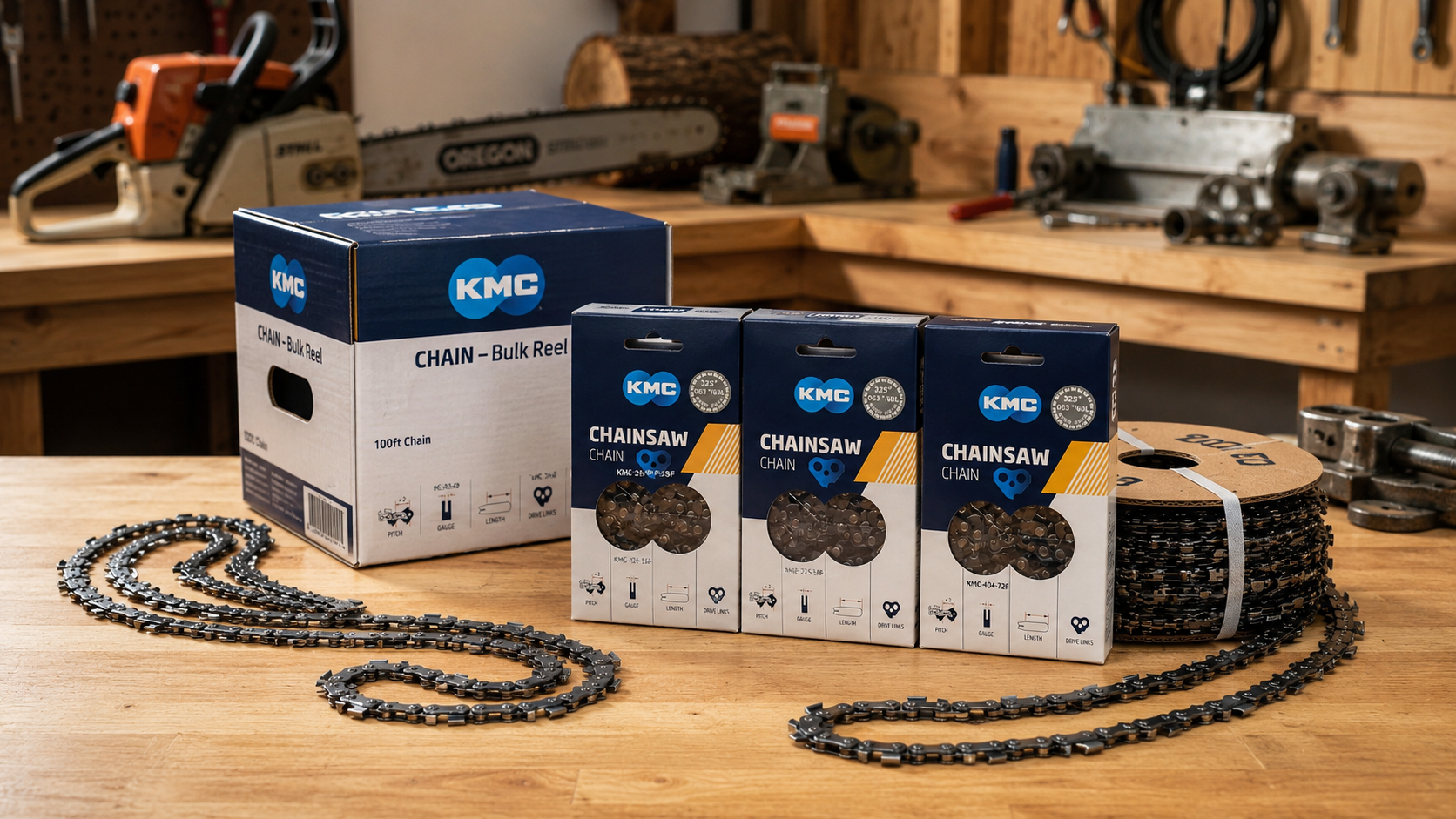
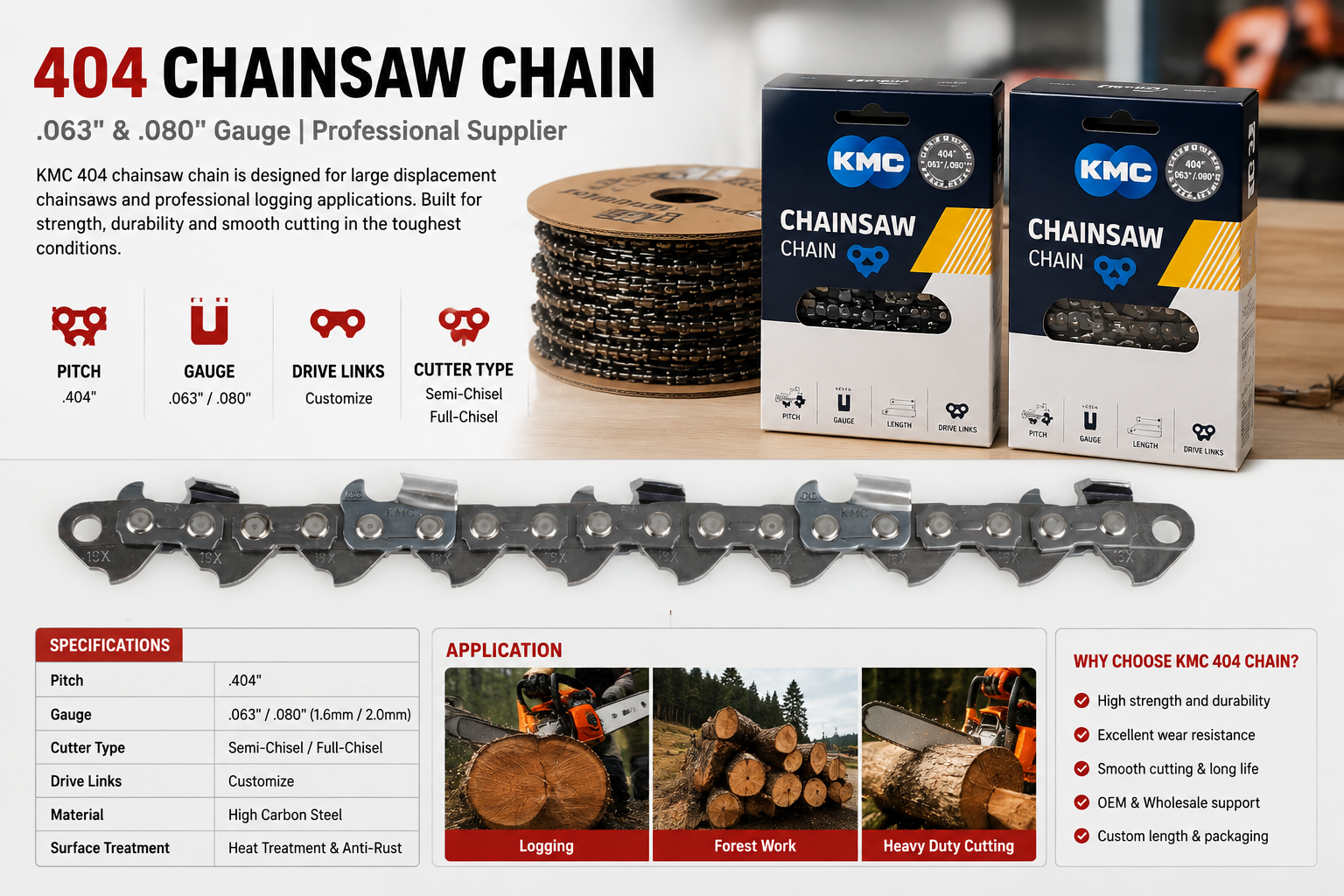
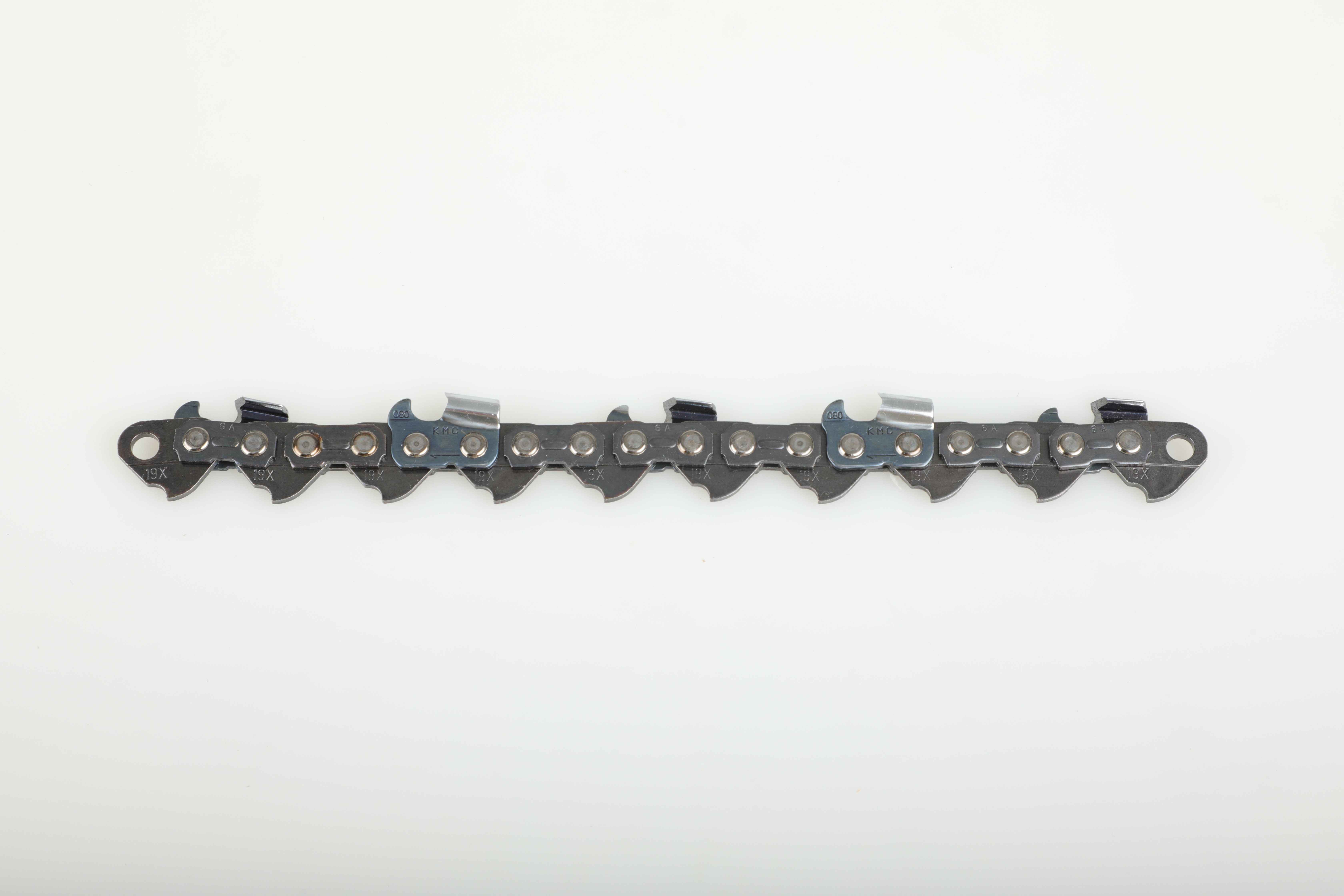
A .404 harvester chain manufacturer should not receive an order based on pitch alone. KMC publishes a .404 .080 semi-chisel harvester chain with 78, 80, 90, 91, 94, 95 and 100 drive links. The buyer must select from those or request another verified count according to the cutting head, bar and sprocket documentation. “.404 chain for a large machine” is not a manufacturing specification.
This guide is for harvester-head distributors, forestry contractors, fleet engineers and parts importers. It focuses on four shortcuts that create wrong orders: using pitch without gauge, using nominal bar length without DL, using DL without the cutting-head system and approving a product photograph without a tagged sample. The correct path keeps .404, .080, DL, cutter and head reference together.
The .404 harvester chain manufacturer must see .080 on every technical record
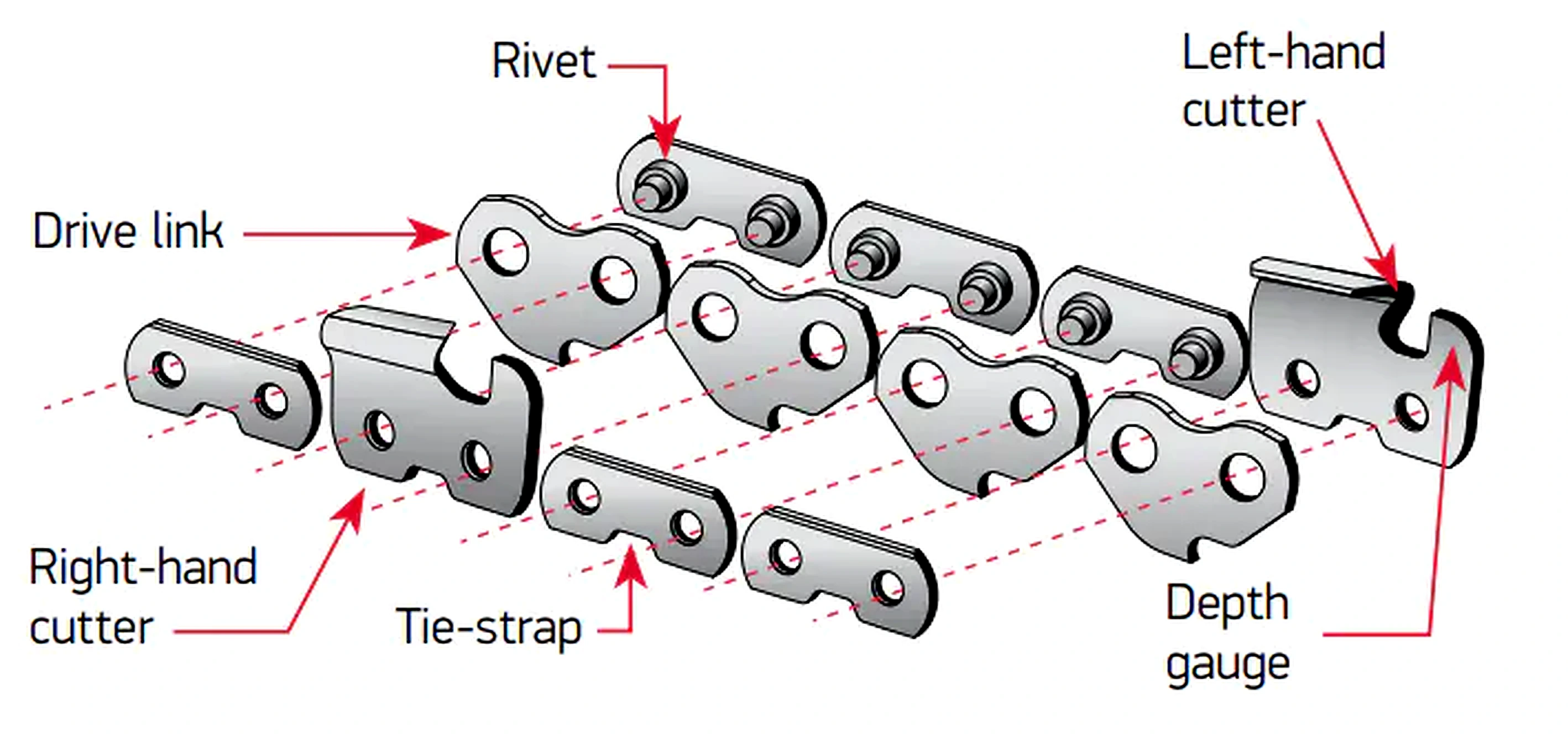
Pitch governs engagement with the drive system; gauge describes the drive-link thickness and matching bar groove. KMC’s .404 category contains both .063-inch (1.6 mm) and .080-inch (2.0 mm) routes. A buyer who writes only .404 has defined one dimension and omitted another.
Official harvester manuals treat the chain as part of a cutting attachment. Record the head model, bar reference and sprocket evidence, then repeat .404 and .080 in the item master. If the machine documentation uses metric units, preserve 2.0 mm beside .080 so purchasing, workshop and supplier read the same gauge.
Shortcut one: “.404” does not identify the bar groove
KMC’s .404 product range publishes .404 .063 chain with 60, 92, 100 and 104 DL in addition to .404 .080 harvester chain. Both products can be described as .404, yet their gauges and applications differ. The .063 route cannot be treated as a thinner substitute for a head requiring .080.
A forestry importer should require gauge on the quotation, sample tag, unit package, carton and receiving screen. If any surface says only .404, the item is not ready to circulate outside the technical team.
Shortcut two: nominal bar length does not replace the DL count
Drive-link count determines loop length within the matching pitch-and-gauge system. Two bars described by a similar nominal cutting length can use different counts because their mount and attachment geometry differ. Select 78, 80, 90, 91, 94, 95 or 100 DL from the actual cutting-head record, not from a general length chart.
If the existing loop is available, count its drive links and compare the result with current equipment documentation. A stretched or worn loop can still provide count evidence, but a photograph laid on a bench cannot reliably communicate gauge or DL. Record the count in writing.
The semi-chisel configuration belongs to the approved .404 .080 item
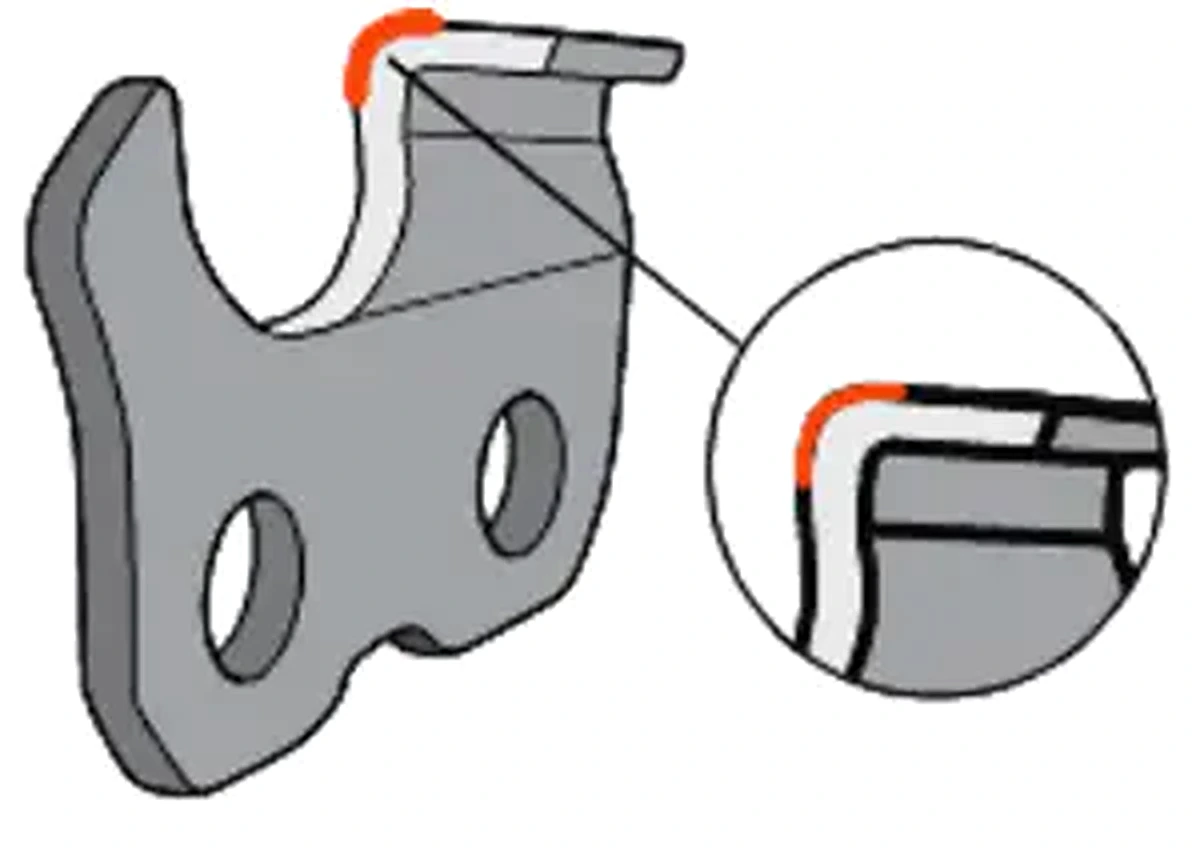
KMC publishes semi-chisel for the .404 .080 product. The rounded working corner is generally selected for edge tolerance where bark contamination, hard timber or frozen conditions may occur. That industry logic explains the application; it does not guarantee a particular production result for every head, setting and timber condition.
Shortcut three: a 100 DL count cannot identify .063 or .080
KMC publishes 100 DL in both .404 .063 and .404 .080 routes. An order line reading “.404 semi-chisel 100 DL” therefore remains incomplete. Add .080/2.0 mm and the mechanized-head reference. This overlap should be highlighted in warehouse training because both packages may look like heavy chain.
A distributor can use item names such as pitch–gauge–DL–application, followed by its own code. The exact syntax is less important than keeping every field visible. Barcode screens and picking tickets should not shorten the description to the shared count.
A tagged physical sample must answer more than a product photograph
A product image can show general cutter form and finish, but it cannot prove the exact loop count, bar-groove match or package content. The manufacturer’s sample should carry .404, .080, DL, semi-chisel, head/bar reference and revision. The buyer counts it and checks the construction named in the approved record.
Shortcut four: visual similarity is not cutting-head compatibility
Two .404 loops can appear similar on a white background. Compatibility comes from dimensions and attachment evidence. Do not mount a questionable sample to see whether it runs. Resolve the record first, then follow the equipment maker’s installation and safety instructions.
The KMC guide to qualifying a harvester manufacturer by cutting head covers the broader engineering handoff. For this .404 .080 item, retain the tagged loop, photographs and inspection notes as the reference for first production.
First production should preserve every approved .404 .080 field
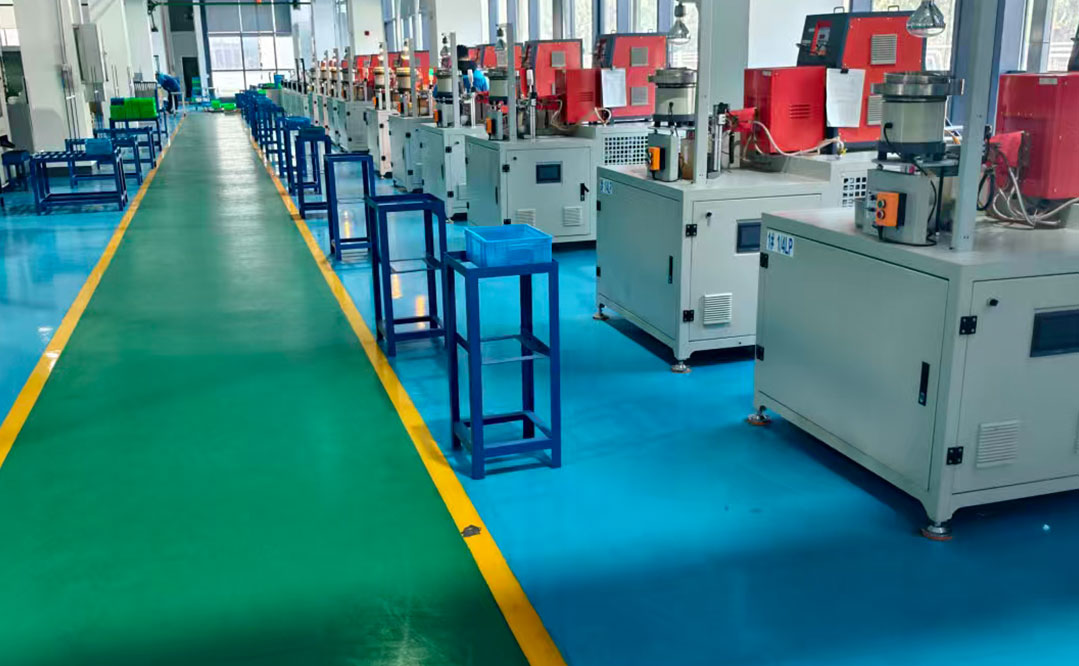
KMC states that its production route includes material composition checks, heat-treatment and hardness control, automatic assembly, cutting tests and final inspection. Agree which lot-specific evidence is required for the order. A general factory control statement does not show that the packed 94 DL item came from the released configuration.
Count changeovers deserve first-piece confirmation
A mixed order may run 90, 94 and 100 DL. At each changeover, the first completed loop should be compared with the item record before the run continues. Remaining labels and components from the previous count need separation. A correct chain in the wrong box is still a failed finished item.

Choose sampled cartons across the run and include every DL, not several units from one easy carton. The inspection record should state SKU, carton location and observed result so the parties can recover the evidence later.
Packaging should identify the loop after forestry cartons are divided
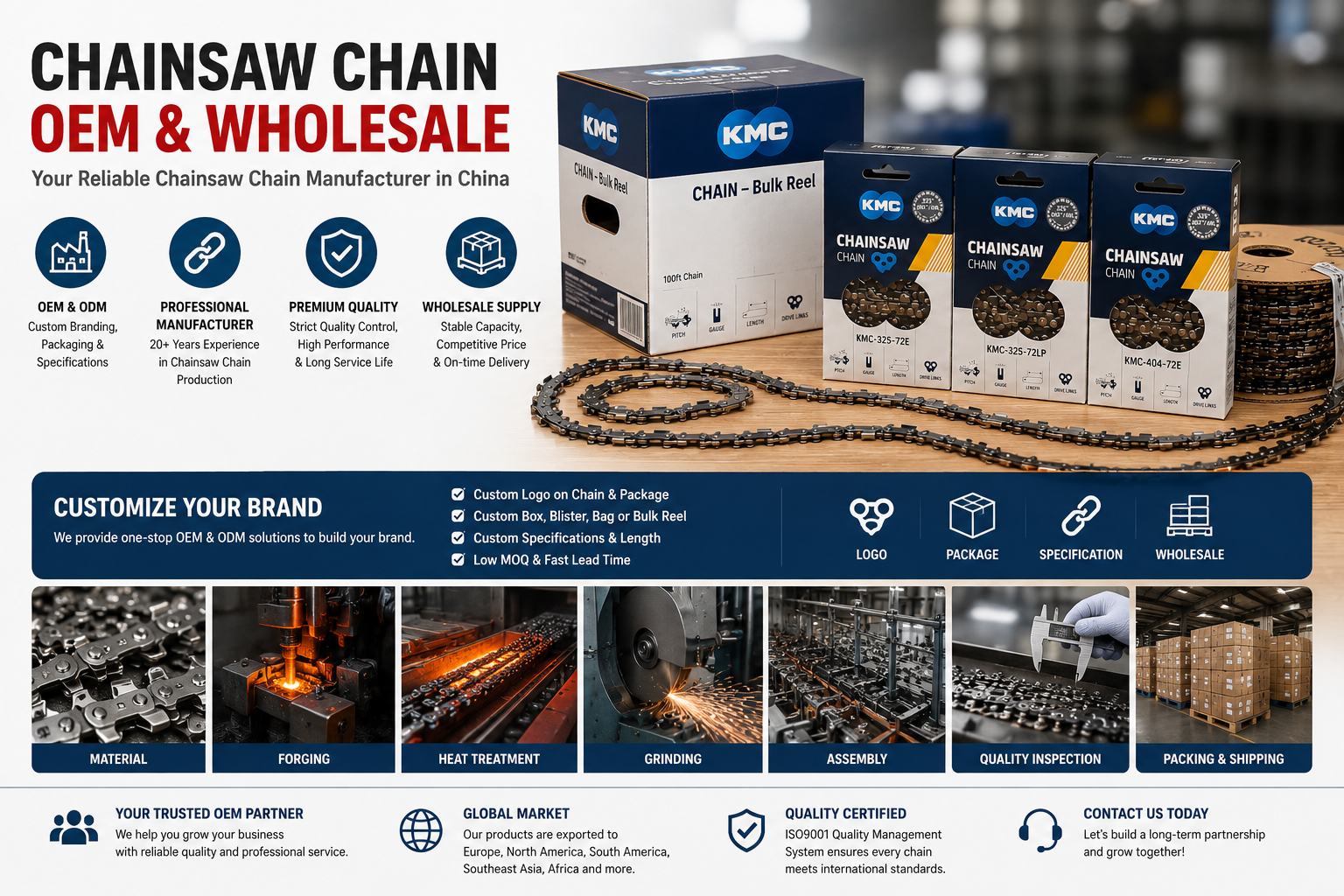
KMC’s OEM page publishes individual boxes, custom cartons, pallets, barcodes and multilingual manuals. Unit packaging must retain .404, .080/2.0 mm, DL and item code. A head reference can support selection but should not replace dimensions.
One service location should never bin all .404 harvester loops together
Divide inventory by approved head/bar route and DL. The package, bin and digital system should show the same identity. If the outer carton is opened, the individual loop still needs its own label. The companion KMC article on harvester supplier replenishment explains how that identity moves through depots and service trucks.
The purchase file should distinguish engineering, commercial and shipping states
The engineering record defines head, bar, sprocket, pitch, gauge, DL and cutter. The commercial record adds quantity, unit price, package code and current schedule. The shipping record adds carton, pallet and destination information. Link them with one buyer SKU, but do not allow a shortened invoice line to replace the engineering definition.
A late carton change should not reopen the cutting-head decision
If the buyer changes carton quantity or label language, issue a new packaging revision and assess the shipping date. The .404 .080 chain remains on its approved technical revision. If DL or gauge changes, engineering approval and the sample route must reopen. A revision table should show which files are affected so time-zone-separated teams do not interpret the same email differently.
KMC publishes indicative timing of 7–10 days for samples, 15–20 days for 1,000–5,000 units, 25–30 days for 5,000–20,000 and 35–45 days above 20,000. Confirm current timing after every material change to the order. A website range cannot reserve a production window or account for unfinished artwork.
Complaint evidence should name the loop and the cutting attachment
If a fleet reports abnormal wear, breakage or poor operation, retain the loop, unit package, order or lot reference and the cutting-head record. Document bar and sprocket condition, lubrication, machine settings, timber condition and maintenance history. This does not decide the cause in advance; it gives manufacturer and fleet enough evidence to investigate the same event.
A return marked only “harvester chain failed” cannot isolate a lot
The report should state .404 .080, DL, head, date, observed condition and how the chain was handled after removal. Photograph relevant areas without cleaning away all evidence. Separate transit damage, fitment error, foreign-object damage and ordinary wear from a suspected production issue. Each path needs a different corrective action.
A distributor receiving several claims should group them by exact SKU and lot rather than by the .404 family. If only one DL or shipment is involved, the manufacturer can focus its record review. If different heads and maintenance states are involved, the fleet can compare those variables before assuming one common cause.
Repeat orders should start from the accepted packed reference
After first production passes, retain a tagged technical loop and one accepted unit package. Record the barcode, carton quantity and technical revision. The next purchase order should reference that baseline and list deliberate changes. Copying an old description such as “.404 harvester 100 DL” would drop the .080 gauge that the approval process protected.
Quantity may change without rewriting the .404 .080 identity
Consumption can shift among 90, 94 and 100 DL as the fleet changes bars or machine deployment. Adjust quantity by SKU. A new head or bar creates a new fitment review; it should not silently overwrite the history of the existing item. This preserves receiving data, complaint evidence and service-stock accuracy.
Approve the .404 manufacturer only when every shortcut is closed
Read the final order from left to right: cutting-head reference, .404 pitch, .080/2.0 mm gauge, exact DL, semi-chisel cutter and package revision. Then select a packed unit and trace it back to the sample and production record. If gauge, count or head identity disappears, the order is not ready.
A dependable .404 harvester chain manufacturer does not ask the buyer to trust appearance or a broad product name. It receives a complete attachment specification and returns a loop whose identity survives sample, production, package and field stock. That is the evidence needed before a mechanized-forestry buyer scales the order.